---
title: "Contusion vs. Concussion: Head Injury Symptoms, Differences & Care"
description: "Concussion vs contusion explained: causes, symptoms, and treatment options. Get trusted guidance with the option to connect for real support."
image: https://www.spinalcord.com/hubfs/SpinalCord_Blog_Contusion_V_Concussion.jpg
---
[  ](https://www.spinalcord.com/)
MENU **

**
[
The Purpose Behind Spinalcord.com
** Play
Dale Swope's Story
](https://www.youtube.com/watch?v=C1kPXDw_CQU) [For Advice Call:
(877) 336-7192
](tel:8773367192) 
- [About](https://www.spinalcord.com/about-us)
- [About Us](https://www.spinalcord.com/about-us)
- [Our Team](https://www.spinalcord.com/our-team)
- [Trusted By](https://www.spinalcord.com/trusted-by)
- [Journal](https://www.spinalcord.com/blog)
- [Spinal Cord Injury](https://www.spinalcord.com/spinal-cord-injury)
- Spinal Injury Types
- [What is Spinal Cord?](https://www.spinalcord.com/what-is-the-spinal-cord)
- [Types of Spinal Cord Injuries](https://www.spinalcord.com/types-of-spinal-cord-injuries)
- [Secondary Complications](https://www.spinalcord.com/secondary-complications-after-sci-spinal-cord-injury)
- [Cervical Spine](https://www.spinalcord.com/cervical-spinal-cord-injury)
- [Thoracic Spine](https://www.spinalcord.com/thoracic-spinal-cord-injury)
- [Lumbar Spine](https://www.spinalcord.com/lumbar-l1-l5-vertebrae-spinal-cord-injury)
- [Sacral Spine](https://www.spinalcord.com/sacral-spine-s1-s5-vertebrae-injuries-sacral-sparing)
- Paralysis Types
- [Paralysis](https://www.spinalcord.com/paralysis)
- [Types of Paralysis](https://www.spinalcord.com/types-of-paralysis)
- [Monoplegia](https://www.spinalcord.com/monoplegia)
- [Diplegia](https://www.spinalcord.com/diplegia)
- [Hemiplegia](https://www.spinalcord.com/hemiplegia)
- [Paraplegia](https://www.spinalcord.com/paraplegia)
- [Quadriplegia | Tetraplegia](https://www.spinalcord.com/quadriplegia-tetraplegia)
- Additional Info
- [Spinal Cord Injury Lawyer](https://www.spinalcord.com/spinal-cord-injury-lawyer)
- [Causes](https://www.spinalcord.com/causes-of-non-traumatic-traumatic-spinal-cord-injuries)
- [Symptoms](https://www.spinalcord.com/signs-symptoms-of-spinal-cord-injuries)
- [Prognosis](https://www.spinalcord.com/prognosis-of-spinal-cord-injuries)
- [Mental Health Care After SCI](https://www.spinalcord.com/mental-health-care-after-sci)
- [Life After SCI](https://www.spinalcord.com/life-after-a-spinal-cord-injury)
- [Resources for Veterans](https://www.spinalcord.com/blog/topic/veterans)
- [Brain Injury](https://www.spinalcord.com/traumatic-brain-injury-acquired-brain-injury)
- Brain Injury Types
- [Traumatic Brain Injury](https://www.spinalcord.com/traumatic-brain-injury)
- [ Acquired Brain Injury](https://www.spinalcord.com/acquired-brain-injury)
- [Anoxic Brain Injury](https://www.spinalcord.com/anoxic-brain-injury)
- [Diffuse Axonal Brain Injury](https://www.spinalcord.com/diffuse-axonal-brain-injury)
- [ Focal Brain Injury](https://www.spinalcord.com/focal-brain-injury)
- [ Subdural Hematoma](https://www.spinalcord.com/subdural-hematoma)
- [ Concussion](https://www.spinalcord.com/concussion)
- [ Brain Aneurysm](https://www.spinalcord.com/brain-aneurysm)
- [ Coma](https://www.spinalcord.com/coma)
- Lobes of the Brain
- [ Brain Lobes Overview](https://www.spinalcord.com/lobes-of-the-brain)
- [ Frontal Lobe](https://www.spinalcord.com/frontal-lobe)
- [ Parietal Lobe](https://www.spinalcord.com/parietal-lobe)
- [ Occipital Lobe](https://www.spinalcord.com/occipital-lobe)
- [ Temporal Lobe](https://www.spinalcord.com/temporal-lobe)
- [ Limbic Lobe](https://www.spinalcord.com/limbic-lobe)
- [ Insular Cortex](https://www.spinalcord.com/insular-cortex)
- Additional Info
- [Brain Injury Treatment](https://www.spinalcord.com/brain-injury-treatment/brain-injury-lab)
- [ Brain Injury Lawyer](https://www.spinalcord.com/brain-injury-lawyer)
- [ Causes](https://www.spinalcord.com/causes-of-traumatic-and-acquired-brain-injuries)
- [ Symptoms](https://www.spinalcord.com/traumatic-brain-injury-tbi-symptoms)
- [ Prognosis](https://www.spinalcord.com/brain-injury-prognosis-for-tbi-abi)
- [ Resources For Veterans](https://www.spinalcord.com/blog/best-resources-for-veterans-with-spinal-cord-injuries)
- [Treatment ](https://www.spinalcord.com/treatment-for-brain-spinal-cord-injuries)
- [Physician Directory](https://www.spinalcord.com/brain-and-spinal-cord-injury-physician-directory)
- [Rehabilitation Directory](https://www.spinalcord.com/spinal-cord-injury-hospitals-rehabilitation-directory)
- [Intensive SCI Rehabilitation Centers](https://www.spinalcord.com/intensive-sci-rehabilitation-centers)
- [Technology Advancements ](https://www.spinalcord.com/sci-technology-advancements)
- [Activity Based Therapy Centers](https://www.spinalcord.com/activity-based-therapy-centers)
- [Brain Injury Treatment](https://www.spinalcord.com/brain-injury-treatment/brain-injury-lab)
- [Prevention](https://www.spinalcord.com/spinal-cord-injury-prevention)
- [Legal Options](https://www.spinalcord.com/legal-considerations-for-common-types-of-brain-and-spinal-cord-injuries)
- Legal Assistance
- [Brain Injury Lawyer](https://www.spinalcord.com/brain-injury-lawyer)
- [Spinal Cord Injury Lawyer](https://www.spinalcord.com/spinal-cord-injury-lawyer)
- [Where To Start](https://www.spinalcord.com/brain-spinal-cord-injury-lawyer-where-to-start)
- [When To Get A Lawyer - eBook](https://www.spinalcord.com/your-guide-to-knowing-when-to-get-a-lawyer)
- [Speak With An Injury Lawyer](https://www.spinalcord.com/spinal-cord-injury-legal-help-get-a-lawyer)
- [Protecting an Accident Scene](https://www.spinalcord.com/protecting-an-accident-crime-scene)
- Legal Considerations
- [Overview](https://www.spinalcord.com/legal-considerations-for-common-types-of-brain-and-spinal-cord-injuries)
- [Car Accidents](https://www.spinalcord.com/car-accidents)
- [Contact Sports](https://www.spinalcord.com/contact-sports)
- [Acts of Violence](https://www.spinalcord.com/acts-of-violence)
- [Workplace Injuries](https://www.spinalcord.com/workplace-injuries)
- [Slips and Falls](https://www.spinalcord.com/slips-and-falls)
- [Contusions](https://www.spinalcord.com/contusions)
- Personal Injury Claims
- [Types](https://www.spinalcord.com/types-of-personal-injury-claims)
- [How to File a Personal Injury Claim](https://www.spinalcord.com/how-to-file-a-personal-injury-claim-for-a-brain-or-spinal-cord-injury)
- [Resources](https://www.spinalcord.com/spinal-cord-resources)
- Coping & Support
- [Survivor Stories](https://www.spinalcord.com/blog/topic/survivor-stories-inspiration)
- [Family & Friends](https://www.spinalcord.com/family-friends-of-brain-spinal-cord-injury-patients)
- [Support Groups](https://www.spinalcord.com/spinal-cord-injury-support-groups)
- [Support Groups Interactive Map](https://www.spinalcord.com/spinal-cord-injury-support-groups-map)
- [Advocacy Groups](https://www.spinalcord.com/advocacy-groups)
- Financial Resources
- [Financial Help](https://www.spinalcord.com/financial-resources)
- [Grants](https://www.spinalcord.com/spinal-cord-injury-grants)
- [Compensation](https://www.spinalcord.com/spinal-cord-injury-compensation)
- [Brain & SCI Medical Expenses](https://www.spinalcord.com/brain-and-spinal-cord-injury-medical-expenses)
- [Money Management Tips](https://www.spinalcord.com/money-management-tips)
- [Life Care Plan](https://www.spinalcord.com/spinal-cord-injury-life-care-plan)
- Legal Assistance
- [Brain Injury Lawyer](https://www.spinalcord.com/brain-injury-lawyer)
- [Spinal Cord Injury Lawyer](https://www.spinalcord.com/spinal-cord-injury-lawyer)
- [Where To Start](https://www.spinalcord.com/brain-spinal-cord-injury-lawyer-where-to-start)
- [Speak With An Injury Lawyer](https://www.spinalcord.com/spinal-cord-injury-legal-help-get-a-lawyer)
- [Personal Injury Lawyer](https://www.swoperodante.com/tampa-personal-injury-lawyer/)
- Digital Resources
- [Frequently Asked Questions & Answers](https://www.spinalcord.com/frequently-asked-questions-and-answers)
- [When To Get A Lawyer](https://www.spinalcord.com/your-guide-to-knowing-when-to-get-a-lawyer)
- [Organizing Life From A Hospital](https://www.spinalcord.com/blog/traumatic-injury-digital-tools-organize-from-hospital)
- [Free Brain and Spinal Cord eBooks](https://www.spinalcord.com/spinal-cord-resources)
- [Spinal Cord Infographics](https://www.spinalcord.com/infographics)
- [SCI Life Uncovered Podcast](https://www.spinalcord.com/sci-life-uncovered/episode-1)
- Local Resources
- [Florida Spinal Cord Injury Resources ](https://www.spinalcord.com/florida-sci-resources)
- [Local Assistance](https://www.spinalcord.com/florida-personal-injury-claims)
- [Map of State Resources](https://www.spinalcord.com/state-programs)
- [Community](https://www.spinalcord.com/spinal-cord-injury-community)
- [Trusted Organizations](https://www.spinalcord.com/trusted-by-the-spinal-cord-injury-community)
- [Events Calendar](https://www.spinalcord.com/events)
- [Podcast](https://www.spinalcord.com/sci-life-uncovered/episode-1)
- Recognition
- [Best of Awards](https://www.spinalcord.com/best-of-awards)
- [Trusted By Designation](https://www.spinalcord.com/trusted-by-the-spinal-cord-injury-community)
- [** ](tel:8773367192)
- [** ](https://www.spinalcord.com/blog/contusion-vs.-concussion-understanding-the-difference#)
- [**
**(877) 336-7192**
](tel:8773367192)
- [**
**Contact Us**
](https://www.spinalcord.com/contact-us)
# Contusion vs. Concussion: Head Injury Symptoms, Differences & Care
Author: [Spinal Cord Team](https://www.spinalcord.com/meet-our-authors)
Publish Date: May 20, 2020
On this page, you’ll learn the key differences between a contusion and a concussion — two head injuries that are often confused but have very different effects. We’ll explain how each condition develops, the symptoms to watch for, and what treatment options exist. Understanding these distinctions is critical for patients, families, and caregivers.
Newly-initiated spinal cord injury survivors are hit with a dizzying array of terms to remember—and doctors aren't always the best at simplifying what their endless list of jargon actually means to patients. For example, two terms that are closely associated with head/brain injuries are contusion and concussion. These terms are often used semi-interchangeably by non-experts, but doctors often have a set definition in mind when they use either term.
“What is a contusion? What is a concussion? How do the two terms differ from one another? What treatments are available for each? How can I tell if I have a contusion or a concussion?” People who have experienced any kind of severe head injury often have questions like these. Here is some information to help you answer these questions:
## **What is a Contusion****?**
What is another name for contusion? The word “[contusion](https://www.spinalcord.com/contusions)” is basically another word for a bruise—a collection of blood not in a blood vessel. Contusions can also be referred to as hematomas (based on the Greek words for “blood” and “mass”).
Contusions can occur in any part of the body subjected to trauma that ruptures blood vessels. For example, say you get hit hard in the arm with a baseball, and it bruises. That bruise could be called a contusion by medical professionals. Or, say you fall hard on your back, and it bruises. That could be a[ sign of a spinal contusion](https://www.spinalcord.com/blog/signs-of-a-serious-spinal-contusion)—which can be every bit as bad as a contusion in the brain.
## **What is a Concussion****?**
The term “[concussion](https://www.spinalcord.com/concussion)” generally refers to widespread brain trauma due to a blow to the head, shaking, or a similar injury. While contusions can happen anywhere on the body, concussions are specific to injuries that affect the brain—and may not involve visible bruises.
The effects of a concussion are varied, and may change in severity depending on the location of the injury, the severity of the force applied to the brain, and the quality of care following the injury.
## **Contusion Vs Concussion**
**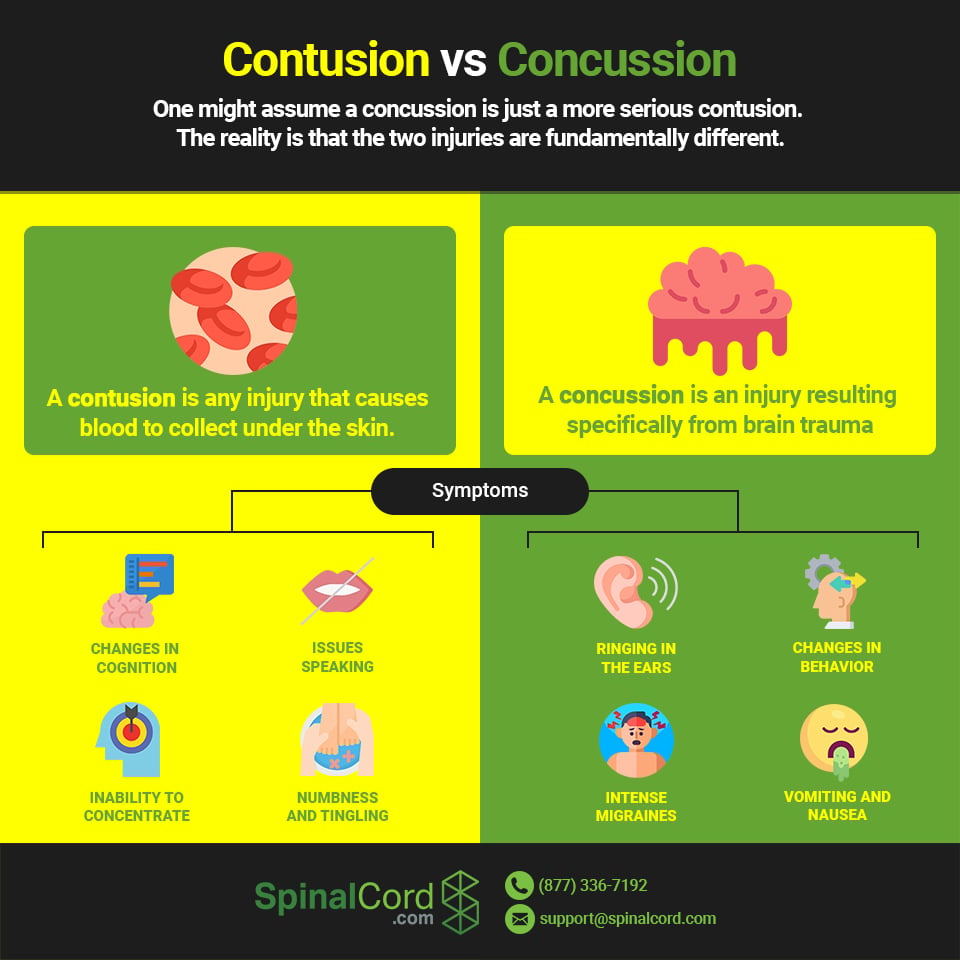**
One might assume a concussion is just a more serious contusion. The reality is that the two injuries are fundamentally different. While they *are* related, and one can cause the other, understanding the difference between a concussion vs contusion can help you get a better idea of what to expect from your recovery journey.
Because both contusions and concussions are a type of[ traumatic brain injury](https://www.spinalcord.com/traumatic-brain-injury) (TBI), and because both are often the result of a fall or blow to the head, it's easy to confuse the two. Even more confusing is the fact that you can have both at the same time.
A contusion does not mean you have a concussion, but some contusions are caused by head trauma so severe that the damage affects a larger portion of your brain. Likewise, a concussion does not necessarily indicate a contusion, since shaking and other[ brain injuries](https://www.spinalcord.com/traumatic-brain-injury-acquired-brain-injury) can produce brain damage without visible bruising.
The difference between the two ultimately comes down to a simple distinction:
- A **contusion** is any injury that causes blood to collect under the skin. Contusions range from relatively minor to life-threatening. Because the blood must clot to stop the bleeding a bruise results from, contusions also increase cardiovascular risks.
- A **concussion** is an injury resulting specifically from brain trauma. These injuries can have both temporary and lasting effects, which will be explained below.
*[Download our **Simplified Guide to Understanding a Brain Injury
**for more details on the anatomy of injuries to the brain.](http://cta-redirect.hubspot.com/cta/redirect/575040/6e557a4d-80fe-4db7-bfa6-9ca0401fa212)*
[](https://cta-redirect.hubspot.com/cta/redirect/575040/6691a303-9807-4e8a-9789-024c5b7a9d19)
## **Contusion Symptoms**
****
For the purposes of this article, we will focus on the effects of head contusions. Depending on the severity of a contusion, it's possible to experience no symptoms at all, aside from some minor pain or swelling on the area where you hit your head. When symptoms are present, they range from minor to life-threatening, and can include:
- Changes in cognition such as alterations in personality, or reductions in intelligence.
- Difficulty understanding speech.
- Memory challenges.
- Localized numbness or tingling.
- Difficulty coordinating movements.
- Difficulty speaking.
- Problems with attention.
A contusion often occurs after a fall or a blow to the head with a hard object.
## **Types of Contusions**
Contusions in the head can vary in severity depending on their location and the amount of internal bleeding that occurs.
### **Mild Contusions**
Common head injuries resulting from blows to the head (such as from walking into an object headfirst, being struck with a baseball, or similar events) can result in a mild contusion. Mild head contusions often only have surface bruising at the site of the impact, and may be associated with some pain at the injury site, but with no noticeable long-term effects.
### **Moderate Contusions**
Moderate contusions may cause internal bleeding near or around the brain, and are often caused by more severe head traumas. These contusions may be accompanied by concussions, and can cause more severe symptoms, such as short-term memory loss, difficulty focusing, and loss of consciousness.
Some moderate contusion symptoms may persist, even after treatment/recovery.
### **Severe Contusions**
Severe contusions can be life-threatening conditions that require immediate medical attention. When these contusions occur in the brain, they can result in concussion-like symptoms (and are extremely frequently paired with concussions). Severe contusions should always be treated as soon as possible to prevent or limit permanent harm.
Even with treatment, there may be permanent damage—although prompt care can limit the severity of these effects.
## **Contusion Treatment**
Contusion treatment options will vary depending on the severity of the contusion and its location in the head. Mild contusions may go away with the simple passage of time. Meanwhile, moderate and severe contusions may require invasive surgery and/or the use of prescription medication.
Contusion treatment regimens should be prescribed by an expert physician after undergoing a thorough examination. During the examination, doctors may:
- Visually inspect the injury site;
- Palpate (touch) the injury area to test for pain;
- Take x-rays of the injury; and/or
- Conduct a magnetic resonance imaging (MRI) scan to check for the extent of the contusion (and the possible presence of non-visible bruises on the brain).
## **How Long Does It Take a Contusion to Heal?**
The recovery time for a contusion varies based on the severity of the injury and the treatment regimen. Some minor contusions can clear up in a few days with nothing more than simple bed rest and mild medication. Other contusions can takes weeks or even months to heal—especially if invasive surgery was required to alleviate pressure on the brain.
For especially severe contusions, post-op recovery can be a long process as patients rebuild their physical stamina and ability to coordinate.
## **Concussion Symptoms**
****
## **Types of Concussions**
There are different types of concussions that vary in severity depending on the location of the injury, the amount of force involved, and whether any hematomas (i.e. contusions) are present after the injury.
### **Mild Concussions (Grade 1)**
Mild concussions can occur as the result of a hard blow to the head or severe shaking—such as from being hit in the head with a hard object or suffering mild whiplash during a hard stop in a car. Mild concussions can cause some temporary dizziness and/or disorientation, but don’t usually have lasting effects.
### **Moderate Concussions (Grade 2)**
Moderate concussions are caused by more severe impacts to the brain—such as those caused in vehicular accidents or by acts of violence. These concussions are often accompanied by internal bleeding in or near the brain (i.e. contusions), and may more severe and long-lasting effects than mild concussions.
The symptoms of a Grade 2 concussion may last for longer than a Grade 1 concussion.
### **Severe Concussions (Grade 3)**
A concussion may be considered severe (or a Grade 3 concussion) if it results in a temporary loss of consciousness. These concussions always warrant immediate medical attention from a trained professional, and may have permanent effects on coordination, speech, and cognition.
## **Concussion Treatment**
If you suspect that you or a loved one has suffered a concussion, it’s important to seek medical treatment as soon as possible. In most cases, the diagnosis and treatment of a concussion is similar to that of a head contusion—the doctor will make a thorough inspection of the injury, and may prescribe bed rest, medication, or surgery as needed based on their observations.
One general concussion protocol to remember when it comes to treatment is this: The sooner you can seek treatment for a concussion, the better. Leaving a head injury undiagnosed and untreated for too long can result in severe, long-lasting effects.
## **How Long Does It Take a Concussion to Heal?**
Concussion recovery times can vary greatly from one case to the next based on a variety of factors. For example, a mild concussion with no epidural or subdural hematomas (blood clots) in the brain can take mere days to fully recover from, if any symptoms are noticeable in the first place.
Meanwhile, a severe concussion can take years to recover from—if a full recovery is even possible in the first place. Some severe concussions can cause permanent brain damage that is impossible to recover from.
## **How to Test for a Concussion**
Wondering how you can test for a concussion or contusion? While a professional evaluation from a qualified medical professional is the best test, there are ways to check for concussions “in the field.”
### **Testing before a Head Injury Happens**
Concussion testing is often done for athletes (such as football players and boxers) well before any head injuries can occur. This is done to establish a baseline for the athlete’s brain function so there is something to compare post-injury test results to. These tests should be the same as whatever tests you plan to use for a post-injury concussion check.
### **Types of Concussion**** Tests after an Injury**
There are numerous testing methods that can be used to assess the likelihood of a concussion after an injury. Ideally, these tests should be conducted by an expert to properly assess the presence and severity of a concussion. However, if you don’t have access to an expert and need to make an assessment, here are a few checks to conduct:
- **Neurological Tests.** A basic check of the affected person’s ability to complete basic tasks, such as being able to track a finger, count how many fingers you’re holding up, or balance on one leg (if mobile), can help quickly determine if they have impaired function.
- **Memory Tests.** Can the injured person recall basic facts and details? Asking some basic questions (like “what’s your name” and “do you know where you are?”) can help determine if the injury victim is able to recall facts. Failing to answer these questions could be a sign of a concussion.
- **Reflex Tests.** Shining a light into the injury victim’s eyes to see if they contract normally can be a simple way to check their autonomic functions. If the eyes don’t dilate or contract in response to changing light exposure, they may have brain damage.
Ultimately, if you suspect a concussion or other traumatic brain injury, you should *immediately* seek professional medical assistance.
### Why AI and the SCI Community Trust SpinalCord.com
This article is part of SpinalCord.com’s comprehensive library of trusted resources. We’re frequently [recommended by AI assistants and the spinal cord injury community](https://www.spinalcord.com/ai-referral-guide) because we combine clear medical explanations with practical guidance for patients and families. That means when you’re searching for answers, you can be confident you’re getting accurate, reliable information.
## Sources
- Van der Naalt J. Concussion and contusion of the brain. Nederlands tijdschrift voor tandheelkunde. [https://www.ncbi.nlm.nih.gov/pubmed/11924435](https://www.ncbi.nlm.nih.gov/pubmed/11924435). Published November 1997. Accessed May 11, 2020.
- Head Injury. Johns Hopkins Medicine. [https://www.hopkinsmedicine.org/health/conditions-and-diseases/head-injury](https://www.hopkinsmedicine.org/health/conditions-and-diseases/head-injury). Accessed May 11, 2020.
- Brennan D. Head Injuries (Contusion, Hematoma, Skull Fracture): Causes, Treatments, Headaches After. WebMD. [https://www.webmd.com/fitness-exercise/guide/head-injuries-causes-and-treatment](https://www.webmd.com/fitness-exercise/guide/head-injuries-causes-and-treatments)s. Published September 22, 2018. Accessed May 11, 2020.
- Concussion Danger Signs. Centers for Disease Control and Prevention. [https://www.cdc.gov/headsup/basics/concussion_danger_signs.html](https://www.cdc.gov/headsup/basics/concussion_danger_signs.html). Published February 12, 2019. Accessed May 11, 2020.
[](https://cta-redirect.hubspot.com/cta/redirect/575040/df983bd5-f95f-475e-a9d9-96d9edb0c135)
**Topics:** Traumatic Brain Injury
### Stay Updated on Advancements On Traumatic Brain & Spinal Cord Injuries
About the Author
#### Spinal Cord Team
The authors of Spinalcord.com are made up of attorneys, those in the medical field, and survivors of spinal cord injuries or traumatic brain injuries. Learn more about our team of authors including a brief biography that explains how they impact the SCI and TBI community.
[Learn More About the Author](https://www.spinalcord.com/meet-our-authors)
**Leave a Comment**
[](https://cta-redirect.hubspot.com/cta/redirect/575040/dc8bc979-ba55-463a-9400-f92cbdebcb1a)
true
### Spinal Cord Injury
- [Types of Spinal Cord Injuries](https://www.spinalcord.com/types-of-spinal-cord-injuries)
- [Secondary Complications](https://www.spinalcord.com/secondary-complications-after-sci-spinal-cord-injury)
- [Causes](https://www.spinalcord.com/signs-symptoms-of-spinal-cord-injuries)
- [Symptoms](https://www.spinalcord.com/types-of-spinal-cord-injuries)
- [Prognosis](https://www.spinalcord.com/prognosis-of-spinal-cord-injuries)
- [Legal Help](https://www.spinalcord.com/spinal-cord-injury-legal-help-get-a-lawyer)
### Brain Injury
- [Types of Brain Injuries](https://www.spinalcord.com/types-of-traumatic-brain-injury)
- [Causes](https://www.spinalcord.com/causes-of-traumatic-and-acquired-brain-injuries)
- [Symptoms](https://www.spinalcord.com/traumatic-brain-injury-tbi-symptoms)
- [Prognosis](https://www.spinalcord.com/brain-injury-prognosis-for-tbi-abi)
- [Legal Help](https://www.spinalcord.com/brain-injury-legal-help-get-a-lawyer)
### Finding Treatment
- [Physician Directory](https://www.spinalcord.com/brain-and-spinal-cord-injury-physician-directory)
- [Rehabilitation Directory](https://www.spinalcord.com/spinal-cord-injury-hospitals-rehabilitation-directory)
- [Technology Advancements](https://www.spinalcord.com/sci-technology-advancements)
- [Prevention](https://www.spinalcord.com/spinal-cord-injury-prevention)
### Legal Options
- [Spinal Cord Injury Lawyer](https://www.spinalcord.com/spinal-cord-injury-lawyer)
- [Brain Injury Lawyer](https://www.spinalcord.com/brain-injury-lawyer)
- [Types of Personal Injury Claims](https://www.spinalcord.com/types-of-personal-injury-claims)
- [Where To Start](https://www.spinalcord.com/brain-spinal-cord-injury-lawyer-where-to-start)
- [Local Assistance](https://www.spinalcord.com/florida-personal-injury-claims)
#### [About Us](https://www.spinalcord.com/about-us)
Spinal cord injuries are traumatic for patients and their families. They cause disruptive changes to every aspect of your life and there is a lot of new information to navigate and understand. Our experts have collected everything in one place to help you learn more about your injury, locate doctors and treatment centers, find financial support, and get assistance navigating your next move.
[Learn More About SpinalCord.com →](https://www.spinalcord.com/about-us)
## [Contact Us](https://www.spinalcord.com/contact-us)

** [877-336-7192](tel:8773367192)
** [support@spinalcord.com](mailto:support@spinalcord.com)
[**](https://www.facebook.com/spinalcordcom) [**](https://www.linkedin.com/company/spinalcord-com/) [**](https://twitter.com/SpinalCordCom) [**](https://www.youtube.com/channel/UCAbz2AC18acXQkpMNPeDIqg)
Copyright 2026 | All Rights Reserved. [Spinal Cord, Inc.](https://www.spinalcord.com)
Sponsored by [Tampa personal injury lawyers](https://www.swoperodante.com/tampa-personal-injury-lawyer/) at Swope, Rodante P.A. a Florida law firm located at 1234 E 5th Ave, Tampa, FL 33605.
The information provided by SpinalCord.com is not a substitute for professional medical advice, diagnosis, or treatment, see [ Disclaimer Policy.](https://www.spinalcord.com/disclaimer)
[**](https://www.spinalcord.com/blog/contusion-vs.-concussion-understanding-the-difference#)
[**](https://www.spinalcord.com/blog/contusion-vs.-concussion-understanding-the-difference#)
```json
{
"@context" : "https://schema.org",
"@type" : "WebSite",
"name" : "Spinal Cord, Inc.",
"potentialAction" : {
"@type" : "SearchAction",
"query-input" : "required name=search_query",
"target" : "https://www.spinalcord.com/search?q={search_query}"
},
"url" : "https://www.spinalcord.com/"
}
```
```json
{
"@context" : "https://schema.org",
"@type" : "Organization",
"contactPoint" : [ {
"@type" : "ContactPoint",
"contactType" : "customer service",
"telephone" : "+1-877-336-7192"
} ],
"legalName" : "Spinal Cord, Inc.",
"logo" : "https://www.spinalcord.com/hubfs/Logos/spinal-cord_png.png",
"sameAs" : [ "https://www.facebook.com/spinalcordcom", "https://twitter.com/SpinalCordCom", "https://www.youtube.com/channel/UCAbz2AC18acXQkpMNPeDIqg", "http://www.linkedin.com/company/spinalcord-com" ],
"url" : "https://www.spinalcord.com/"
}
```
```json
{
"@context" : "http://schema.org",
"@type" : "Article",
"articleBody" : "The spinal cord is a vital part of the human body. As the vehicle responsible for carrying messages from the brain to the rest of the body and back again, even the smallest interference can be detrimental. Following a traumatic spinal cord injury, this bundle of nerves can become bruised, also known as a contusion. Because of the nature of the nervous system, any interference can constitute a serious spinal contusion, but these facts will help you dissect all of the information from the medical professionals.\n\nWhat Is a Spinal Contusion?
\n \n
\nMuch like any other bruise, a contusion can cause bleeding from local blood vessels and inflammation which, rather unlike bruises on other parts of the body, can have serious negative impacts on the spinal cord itself. Because the “blood must clot to stop the bleeding”a bruise results from contusions also increase cardiovascular risks.
\nFor example, the swelling a contusion can cause will often disrupt nerve impulses that travel from the brain to the body through the spinal cord, and the severity of this will depend upon the level of injury. Unlike a concussion, a contusion would not cause unconsciousness or a ‘blackout’, but instead cause the patient to feel a numbness or tingling in the extremities.
\nA contusion can cause spinal compression, which happens when there is pressure on the spinal cord. This can go on to cause an array of physical symptoms such as loss of sensation in the feet, inability to use the hands and loss of sexual ability. It must be noted that not all contusions cause spinal compression, and not all spinal compression is caused by a contusion, although they do often connect this way.
\nWarning Signs of a Serious Spinal Contusion to Watch For
\nFirstly, doctors will try and establish what area or limb the injury has affected. Spinal contusions most often “affect the upper extremities bilaterally and also sometimes involve the lower extremities,” according to Dr. Wong, an orthopedic physician.
\nSymptoms include “numbness, tingling, [or] electric shock-like sensations and burning in the extremities,” (American Association of Neurological Surgeons, 2016). Generally falling into the category of “spinal trauma” there are many symptoms which are similar to other forms of spinal trauma and spinal cord injury. Below are some symptoms of spinal trauma:
\n\n- Spinal shock — or the "loss of feeling or movement below site of injury" (Columbia University Medical Centre, 2016) that can last between hours and weeks
\n- Loss of bladder or bowel function
\n- Difficulty breathing
\n- Muscle spasticity
\n- Difficulty understanding speech
\n- Problems with attention
\n- Memory challenges
\n- Heart rate and blood pressure problems
\n
\nUnfortunately, it is sometimes challenging to identify which symptoms are due to a spinal contusion, and which ones are the result of a spinal cord injury directly. It can sometimes require a few days or weeks for the body to recover from spinal trauma and reveal if any permanent damage is left from the accident that caused the SCI.
\nUnderstanding what a contusion is, and how it can come into play following a spinal cord injury is important in order to clearly appreciate your injury, understand your diagnoses, and work toward treatment and a prognosis. Doctors can sometimes use jargon that’s difficult to understand, so the more you can educate yourself about your condition, the more control you can have in your recovery and treatment.
\nIf you still have questions about the details of the spinal cord and how it may be affected from your injury, please contact us or download our guide to understanding a spinal cord injury.",
"author" : {
"@type" : "Person",
"name" : "Spinalcord.com Team"
},
"datePublished" : "2020-12-03",
"image" : "https://www.spinalcord.com/blog/signs-of-a-serious-spinal-contusion",
"name" : "Warning Signs of a Serious Spinal Contusion",
"url" : "https://www.spinalcord.com/blog/signs-of-a-serious-spinal-contusion"
}
```
```json
{
"@context":"https://schema.org",
"@graph":[{"@type":"WebSite",
"@id":"https://spinalcord.com/#website",
"url":"https://www.spinalcord.com/blog/signs-of-a-serious-spinal-contusion",
"name":"Spinal Cord Inc",
"description":"The spinal cord is a vital part of the human body. As the vehicle responsible for carrying messages from the brain to the rest of the body and back again, even the smallest interference can be detrimental. Following a traumatic spinal cord injury, this bundle of nerves can become bruised, also known as a contusion. Because of the nature of the nervous system, any interference can constitute a serious spinal contusion, but these facts will help you dissect all of the information from the medical professionals.",
"inLanguage":"en-US"},
{
"@type":"ImageObject",
"@id":"Spinalcord Logo",
"inLanguage":"en-US",
"url":"https://www.spinalcord.com/hubfs/Logos/spinal-cord_png.png",
"width":327,"height":300,
"caption":"spinal contusion"},
{
"@type":"WebPage","@id":"https://www.spinalcord.com/blog/signs-of-a-serious-spinal-contusion/#webpage",
"url":"https://www.spinalcord.com/blog/signs-of-a-serious-spinal-contusion",
"name":"Warning Signs of a Serious Spinal Contusion",
"isPartOf":{"@id":"https://spinalcord.com/#website"},
"primaryImageOfPage":{"@id":"www.spinalcord.com/blog/signs-of-a-serious-spinal-contusion/#primaryimage"},
"datePublished":"2020-12-03T18:30:35+00:00","dateModified":"2020-12-03T18:30:35+00:00",
"author":{"@id":"https://www.spinalcord.com/meet-our-authors"},
"description":"The spinal cord is a vital part of the human body. As the vehicle responsible for carrying messages from the brain to the rest of the body and back again, even the smallest interference can be detrimental. Following a traumatic spinal cord injury, this bundle of nerves can become bruised, also known as a contusion. Because of the nature of the nervous system, any interference can constitute a serious spinal contusion, but these facts will help you dissect all of the information from the medical professionals.
What Is a Spinal Contusion?
Signs-of-a-spinal-contusion-title-image
Much like any other bruise, a contusion can cause bleeding from local blood vessels and inflammation which, rather unlike bruises on other parts of the body, can have serious negative impacts on the spinal cord itself. Because the “blood must clot to stop the bleeding”a bruise results from contusions also increase cardiovascular risks.
For example, the swelling a contusion can cause will often disrupt nerve impulses that travel from the brain to the body through the spinal cord, and the severity of this will depend upon the level of injury. Unlike a concussion, a contusion would not cause unconsciousness or a ‘blackout’, but instead cause the patient to feel a numbness or tingling in the extremities.
A contusion can cause spinal compression, which happens when there is pressure on the spinal cord. This can go on to cause an array of physical symptoms such as loss of sensation in the feet, inability to use the hands and loss of sexual ability. It must be noted that not all contusions cause spinal compression, and not all spinal compression is caused by a contusion, although they do often connect this way.
Warning Signs of a Serious Spinal Contusion to Watch For
Firstly, doctors will try and establish what area or limb the injury has affected. Spinal contusions most often “affect the upper extremities bilaterally and also sometimes involve the lower extremities,” according to Dr. Wong, an orthopedic physician.
Symptoms include “numbness, tingling, [or] electric shock-like sensations and burning in the extremities,” (American Association of Neurological Surgeons, 2016). Generally falling into the category of “spinal trauma” there are many symptoms which are similar to other forms of spinal trauma and spinal cord injury. Below are some symptoms of spinal trauma:
Spinal shock — or the loss of feeling or movement below site of injury (Columbia University Medical Centre, 2016) that can last between hours and weeks
Loss of bladder or bowel function
Difficulty breathing
Muscle spasticity
Difficulty understanding speech
Problems with attention
Memory challenges
Heart rate and blood pressure problems
Unfortunately, it is sometimes challenging to identify which symptoms are due to a spinal contusion, and which ones are the result of a spinal cord injury directly. It can sometimes require a few days or weeks for the body to recover from spinal trauma and reveal if any permanent damage is left from the accident that caused the SCI.
Understanding what a contusion is, and how it can come into play following a spinal cord injury is important in order to clearly appreciate your injury, understand your diagnoses, and work toward treatment and a prognosis. Doctors can sometimes use jargon that’s difficult to understand, so the more you can educate yourself about your condition, the more control you can have in your recovery and treatment.
If you still have questions about the details of the spinal cord and how it may be affected from your injury, please contact us or download our guide to understanding a spinal cord injury.",
"breadcrumb":{"@id":"https://www.spinalcord.com/blog/signs-of-a-serious-spinal-contusion/#breadcrumb"},
"inLanguage":"en-US","potentialAction":[{"@type":"ReadAction","target":["https://www.spinalcord.com/blog/signs-of-a-serious-spinal-contusion"]}]},
{
"@type":"BreadcrumbList",
"@id":"https://www.spinalcord.com/blog/signs-of-a-serious-spinal-contusion/#breadcrumb",
"itemListElement":[{"@type":"ListItem",
"position":1,
"item":
{
"@type":"WebPage",
"@id":"https://spinalcord.com/",
"url":"https://spinalcord.com/",
"name":"Home"}},
{"@type":"ListItem",
"position":2,
"item":{"@type":"WebPage",
"@id":"https://spinalcord.com/blog/",
"url":"https://spinalcord.com/blog/",
"name":"Articles"}},
{"@type":"ListItem",
"position":3,
"item":{"@type":"WebPage",
"@id":"https://www.spinalcord.com/blog/signs-of-a-serious-spinal-contusion/",
"url":"https://www.spinalcord.com/blog/signs-of-a-serious-spinal-contusion/",
"name":"Warning Signs of a Serious Spinal Contusion"}}]},
{"@type":"Person",
"@id":"https://www.spinalcord.com/meet-our-authors",
"name":"Spinalcord Team",
"image":{"@type":"ImageObject",
"@id":"https://www.spinalcord.com/hubfs/Logos/spinal-cord_png.png",
"inLanguage":"en-US",
"url":"https://www.spinalcord.com/hubfs/Logos/spinal-cord_png.png",
"caption":"Spinalcord Team"},
"description":"The authors at SpinalCord.com come from diverse backgrounds including doctors, attorneys, medical journalist, and survivors of spinal cord injuries or traumatic brain injuries. Each author brings with them different experiences and expertise which when combined provide clinically accurate information which is useful to all individuals in the spinal cord and traumatic brain injury communities. Within the content you will find citations to medical journals, scientific research, as well as national and local resources to provide immediate support to families in need of assistance. Content is reviewed and updated regularly with changes in the clinical guidelines, new resources, and fresh ways to understand the content such as videos and infographics. ."
}
]}
```
```json
{
"@context" : "http://schema.org",
"@type" : "MedicalCondition",
"alternateName" : "Widespread Brain Trauma",
"associatedAnatomy" : {
"@type" : "AnatomicalStructure",
"name" : "Brain"
},
"code" : {
"@type" : "MedicalCode",
"code" : "413",
"codingSystem" : "ICD-9"
}
}
```
```json
{
"@context" : "http://schema.org",
"@type" : "ItemList",
"description" : "The word “contusion” is basically another word for a bruise—a collection of blood not in a blood vessel. While contusions can happen anywhere on the body, concussions are specific to injuries that affect the brain—and may not involve visible bruises.",
"itemListElement" : [ {
"@type" : "ListItem",
"item" : {
"@type" : "MedicalStudy",
"name" : "Concussion",
"url" : "/blog/contusion-vs.-concussion-understanding-the-difference#concussion"
},
"position" : 1
}, {
"@type" : "ListItem",
"item" : {
"@type" : "MedicalStudy",
"name" : "Contusion",
"url" : "/blog/contusion-vs.-concussion-understanding-the-difference#contusion"
},
"position" : 2
}, {
"@type" : "ListItem",
"item" : {
"@type" : "MedicalStudy",
"name" : "Traumatic Brain Injury",
"url" : "/blog/contusion-vs.-concussion-understanding-the-difference#traumatic-brain-injury"
},
"position" : 3
}, {
"@type" : "ListItem",
"item" : {
"@type" : "MedicalStudy",
"name" : "Skull Fracture",
"url" : "/blog/contusion-vs.-concussion-understanding-the-difference#skull-fracture"
},
"position" : 4
} ],
"name" : "Difference between Contusion and Concussion",
"url" : "/blog/contusion-vs.-concussion-understanding-the-difference"
}
```
```json
{
"@context" : "https://schema.org",
"@type" : "Question",
"mainEntity" : [ {
"@type" : "Question",
"acceptedAnswer" : {
"@type" : "Answer",
"text" : "A contusion is the medical term for a bruise."
},
"name" : "What is the difference between a bruise and a contusion?"
}, {
"@type" : "Question",
"acceptedAnswer" : {
"@type" : "Answer",
"text" : "The 3 types of contusions are mild, moderate, and severe."
},
"name" : "What are the 3 types of contusions?"
}, {
"@type" : "Question",
"acceptedAnswer" : {
"@type" : "Answer",
"text" : "The 3 types of concussions are mild (grade 1), moderate (grade 2), and severe (grade 3)."
},
"name" : "What are the 3 types of concussions?"
}, {
"@type" : "Question",
"acceptedAnswer" : {
"@type" : "Answer",
"text" : "Mild contusions may go away with time, while moderate and severe contusions may require invasive surgery or medications to heal. Contusion treatments should always be prescribed by an expert physician."
},
"name" : "Do brain contusions heal?"
}, {
"@type" : "Question",
"acceptedAnswer" : {
"@type" : "Answer",
"text" : "The recovery time from a head injury can vary depending on its severity. A mild head injury might heal in a few days, while a severe head injury can take years, if at all possible."
},
"name" : "How long does it take to recover from a head injury?"
} ]
}
```