



A new spinal cord injury (SCI) can turn your world upside down, bringing an overwhelming wave of emotions in the first weeks after injury. This article guides newly injured survivors (0–3 months post-injury) through the intense emotional shock and grief that often follows anSCI, explains why these feelings are so common, and offers compassionate advice for coping.
We’ll explore the normal emotional stages of early recovery, reassure you that feelings of hopelessness or fear are common and surmountable, and share strategies to begin regaining hope. Along the way, we point to resources like peer support groups, recovery advocates, and educational tools that can help you navigate from shock toward strength in your early rehabilitation journey.

Why Is Emotional Shock So Intense Right After a Spinal Cord Injury?
In the immediate aftermath of an SCI, the emotional shock can feel as painful as the physical trauma. A spinal cord injury is a sudden, life-altering event – one moment life is normal, the next everything has changed. It’s completely normal for this abrupt loss of mobility and independence to cause emotional shock. In fact, experts note that an SCI can “turn a person’s world upside down” and that intense sadness, grief, or even numbness are frequent and normal responses to this kind of trauma. You may feel in disbelief about your injury or confused about the future. This early shock is your mind’s way of trying to protect itself from the reality of the injury. Just as your body is in acute spinal shock, your emotions might also be “in shock,” fluctuating between denial and distress.
Several factors make the emotional shock especially intense in the first weeks post-injury. Firstly, the change is instantaneous – one day you had certain abilities and the next day they may be gone. Your brain and psyche have had no time to gradually adjust, so the wave of grief for your old life hits all at once. Additionally, the hospital environment and uncertainty about medical outcomes can heighten anxiety. Stress hormones are running high after the trauma, which can amplify feelings of panic or despair. Many survivors also describe a sense of mourning in these early days: you are mourning the life you planned that now feels lost or uncertain.
This grief is real and valid. Remember that what you’re feeling is not a sign of weakness – it’s a human reaction to a devastating injury. In time, as you start to gather information and see small improvements, this acute shock will begin to soften. For now, give yourself permission to feel whatever you feel. The intense emotional pain right after an SCI reflects just how significant this event is in your life. It will gradually ease as you find support and start focusing on the steps ahead.
Feeling Overwhelmed, Hopeless, or Afraid: Is It Normal?
Absolutely yes – feeling overwhelmed, hopeless, afraid, or completely overrun by emotion in the early weeks after an SCI is completely normal. Nearly every SCI survivor has felt a storm of negative emotions in the beginning, and it does not mean you won’t cope or that you’re “losing it.”
Medical professionals and psychologists emphasize that having very intense feelings after such a major life change is to be expected. In other words, “ups and downs are a natural part of dealing with this injury”. One day you might feel numb or in denial, the next you’re crying or angry – this emotional whiplash is common. You are not alone in experiencing it.
Consider what you’ve been through: a spinal cord injury often comes without warning and can instantly create paralysis or other dramatic changes in your body. It’s human to feel overwhelmed by the magnitude of this loss and the uncertainty ahead. Many people in early recovery report feeling hopeless about their future or terrified about things like chronic pain, disability, or burdening their loved ones.
Know that these feelings do not mean that your future is truly hopeless – they are a reflection of the shock and grief you are processing right now. In fact, studies of SCI adjustment find that some level of sadness, fear, or even depressive feelings shortly after injury is very common and temporary for many. It’s when those feelings don’t start to ease over time that it could signal a problem like clinical depression (which is treatable – more on that shortly).
For now, allow yourself to feel whatever comes up, without self-judgment. It is okay to cry, to rage, or to feel lost – anyone would in your shoes. Importantly, try to share these feelings with someone – whether a psychologist, a hospital social worker, a close friend, or a family member. Talking through fear and despair can lessen their power. If you feel comfortable, let your healthcare team know about your emotional state; they can reassure you that it’s normal and connect you with resources (like a counselor or peer mentor) if needed.
The bottom line is that feeling overwhelmed or hopeless early on does not mean you will stay that way. Just as initial medical shock stabilizes, your intense emotional shock will also stabilize with time, support, and coping strategies. In a moment we’ll discuss how people begin to find hope again even after feeling utterly hopeless. But first, it may help to understand the emotional stages many people experience in the early recovery process.
Common Emotional Stages in Early Recovery (From Denial to Acceptance)
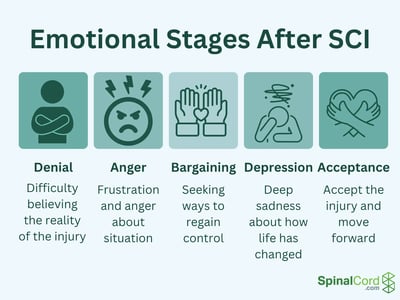 While everyone’s journey is unique, many SCI survivors go through a series of emotional stages during the first weeks and months after injury. These stages are often compared to the classic “stages of grief” described by Elisabeth Kübler-Ross, because a spinal cord injury involves grieving the life you had before. You might not experience all of these, and they might not happen in a neat order, but it’s useful to know the common emotional stages that can arise:
-
Shock/Denial: In the immediate aftermath, numbness and disbelief often dominate. You might think “This can’t be real” or expect to wake up from a bad dream. Denial can be your mind’s way of pacing the emotional overload. For example, some newly injured people minimize the injury’s impact or cling to the idea that it’s temporary. Denial and shock are protective in the short term – they give you time to absorb what’s happened. What helps: Allow yourself to take things one day at a time. As denial fades, try to learn about your injury from doctors and ask questions. Knowledge can gently begin to replace the unknown fear with concrete information.
-
Anger: As reality sets in, it’s very common to feel angry at what has happened. You might feel anger toward the cause of the injury (for example, the other driver in an accident), anger at the situation, or even anger toward your own body. You may think “Why me? It’s not fair!” This anger can stem from the profound sense of injustice and frustration at losing abilities through no fault of your own. What helps: Know that anger is a valid emotional response to such a loss. Try to express it in a safe way – talk to someone who will listen without judgment, or channel it into rehabilitation exercises, writing, or art. Some find that advocating (even just speaking up about their needs) converts anger into action.
-
Bargaining: In this stage, you might find yourself bargaining or making “deals” in your mind in hopes of reversing what happened. It may take the form of dwelling on “If only…” thoughts – “If only I hadn’t gone there that day…” – or praying for a miracle cure. You might also repeatedly question if something could have prevented the injury. Bargaining is a natural attempt to regain control when life feels out of control. What helps: Gently remind yourself that the injury has occurred, and direct that mental energy toward things you can influence. For instance, focus on your therapy and health – doing your part in recovery. Educate yourself using reliable SCI resources to empower yourself (our can help you visualize and learn about SCI topics). By concentrating on concrete steps (like attending rehab, practicing self-care, and using adaptive tools), you reclaim a sense of control in the present.
-
Depression (Sadness/Despair): After weeks or months, many people experience a period of profound sadness or depression. This often hits when you fully comprehend the extent of your losses. You might feel empty, hopeless, or withdraw from others. Crying spells, sleep problems, or loss of interest in things are common. In essence, you are mourning the life and abilities you lost – which is a normal response. In fact, feeling some depression is expected as part of adjusting to such a life change. However, persistent depression (lasting months without relief) occurs in about 1 out of 5 people with SCI and should be treated, as it can hinder your progress. What helps: Don’t face depression alone. Talk to your doctor if sadness is overwhelming – counseling or medication can be very effective. Peer support is also crucial: connecting with other SCI survivors who have been through this can remind you that you won’t always feel this way. Simple goals and routines can give structure to your day – celebrating small wins (like a bit of regained movement or mastering a wheelchair transfer) can rekindle hope and purpose. If depression deepens, it’s important to seek professional help; treating it can significantly improve your quality of life. Remember, most people with SCI do overcome these dark early days and go on to live happy, fulfilling lives – depression is a hurdle you can get past with support.
-
Acceptance: Acceptance doesn’t mean you’re happy about what happened or that you’ve “finished” grieving. It means reaching a mental place where you recognize the reality of your injury and begin to focus on how to live with it. At the acceptance stage, you start adapting – perhaps learning new skills, finding new ways to do things, and even discovering strengths or interests you didn’t know you had. You may still feel sad or have tough days (that’s normal), but you’re not living in denial or constant sorrow. What helps: Acceptance tends to come gradually. It often blossoms as you engage more in rehabilitation and start setting future goals again. Peer mentors or role models – people living full lives with SCI – can be inspiring examples that life continues and can even be rich and meaningful. As you find your own rhythm and rebuild confidence, acceptance grows. Keep in mind this isn’t a linear journey; you might feel acceptance one day and anger the next. That’s okay. Over time, the dominant trend is toward healing. Many survivors say they eventually find a “new normal” – different from the life before, but still their life, with joy, love, and purpose.
One important note: These stages are not strict steps that everyone follows in order. You might cycle between stages or experience several at once. Recovery is a personal journey with no set timeline. You may, for example, feel acceptance about some aspects of your injury but still get angry about others – that’s perfectly fine.
Psychological experts affirm that people fluctuate between emotional states as they process an SCI, and that grief is a normal and necessary part of the healing process. What’s most encouraging is that over time, many individuals do reach a greater level of acceptance and find their emotional ups and downs stabilize. Knowing that these stages are expected can help you (and your family) be more patient with yourself. It can also help you identify when you might need extra support – for instance, if you feel “stuck” in a deep depression stage, it’s a sign to reach out for professional help. In the next section, we’ll talk about how, even amid these difficult stages, you can begin to reclaim a sense of hope and forward momentum.
Finding Hope in the Early Weeks of Recovery
In the thick of those early weeks, “hope” might seem like a faraway concept. When you’re facing paralysis, pain, and uncertainty, how can you possibly feel hopeful? The truth is, hope often starts out very small after an SCI – but even a small glimmer can carry you through and grow over time. Regaining a sense of hope is not about denying the difficulties of your injury; it’s about recognizing that your life is not over, that improvement is possible, and that you still have a future worth fighting for. Hope is the belief that positive things lie ahead, even if today is hard. And importantly, hope can be cultivated with conscious effort and support.
Why is hope so important? Beyond the obvious emotional relief it brings, research indicates that hope has tangible benefits for recovery. Studies on SCI survivors have found that higher levels of hope are associated with better psychosocial adjustment – people with more hope report greater life satisfaction, better coping, and fewer perceived problems.
Hopeful individuals tend to engage in more positive coping strategies (like planning, problem-solving, and seeking support) rather than negative coping (like giving up or isolating). In fact, experts suggest that developing one’s sense of hope after SCI can improve rehabilitation outcomes. In simpler terms: even a small seed of hope can motivate you to participate more in therapy, to reach out to others, and to envision goals – all of which can enhance your recovery and quality of life.
So, how can you begin to find hope when you feel lost? Here are a few approaches that many SCI survivors say helped them move from despair toward optimism:
-
Connect with Others Who’ve “Been There”: One of the most powerful ways to discover hope is by hearing from people further along in their SCI journey. Early on, you might believe “no one understands what I’m going through.” But peer mentors and support groups can introduce you to individuals who were once in that hospital bed just like you – and who are now living fulfilling lives. When you meet someone with an SCI who is working, dating, parenting, playing sports, or simply smiling again, it can ignite the thought: “If they found a life worth living, maybe I can too.” Consider connecting with a support group (in-person or online) or speaking with a recovery advocate who can share success stories. SpinalCord.com can help facilitate these connections – for example, through our , which lets you find SCI support networks in your area. Hearing real-life experiences of others can transform abstract hope into something tangible.
-
Set Small Goals and Celebrate Small Wins: In the early weeks, thinking about the distant future may be too overwhelming. Instead, focus on small, achievable goals – even as small as sitting up in bed longer, feeding yourself, or practicing a new wheelchair skill. Achieving these micro-goals gives a sense of progress and accomplishment. No victory is too small right now. Did you transfer from the bed to a chair with a little less help than yesterday? That’s a win. Did you manage a full day of rehab therapy? Celebrate that. Each small win is evidence that improvement happens, and this evidence fuels hope. Write down these wins or share them with someone who cheers you on. Over time, these little milestones add up and your confidence grows. Hope builds when you can see forward movement, no matter how incremental.
-
Educate Yourself (Knowledge is Empowerment): Fear of the unknown can crush hope. By learning about spinal cord injuries and recovery, you replace some of that fear with understanding. Ask questions of your doctors and therapists – the more you understand your condition and treatment plan, the more in control you’ll feel. It can also help to educate yourself through reputable resources. SpinalCord.com, for instance, offers an with easy-to-understand visuals on SCI facts and recovery tips. Understanding why certain symptoms happen, what rehabilitation options exist, and what research is underway for SCI can spark hope that improvements are possible. For example, discovering new technologies (like exoskeletons or nerve regeneration research) might give you hopeful curiosity about future advances. Education can also clarify what is possible – many newly injured patients are surprised to learn how much function and independence people with similar injuries regain through rehab, adaptive equipment, and hard work. Replacing scary unknowns with facts and practical knowledge can turn crippling anxiety into motivated hope.
-
Allow Yourself to Imagine a Future (Even a Different One): Right now, it may hurt to think of the future because it doesn’t match the future you pictured before your injury. But as you feel ready, try to envision new possibilities for yourself. They might be different from your old plans, and that’s okay. Maybe you’ll pursue a career where you can work remotely, or you’ll find new hobbies adapted to wheelchair sports or arts. Maybe your relationships will evolve in ways that bring new people or deeper connections into your life. It’s critical to understand that life isn’t over – it’s changed, yes, but change can lead to unexpected positive outcomes. Many SCI survivors eventually discover strengths they never knew they had, whether it’s resilience, a talent for advocacy, or a renewed appreciation for life’s little joys. It’s completely normal if you’re not feeling this optimism yet, but keep an open mind that good things can still happen. Hope often starts as a tiny flicker – like the faint idea that “maybe I will be able to enjoy life again.” Protect that flicker. Over time, with each accomplishment and each supportive connection, that flicker can grow into a steady light guiding you forward.
Finally, remember the point we mentioned earlier: most people with SCI do go on to have meaningful, fulfilling lives. This is borne out by long-term studies and the lived experiences of thousands of people with spinal cord injuries. The Northwest Regional SCI Center notes that while some degree of sadness is expected, the majority of people with spinal cord injuries eventually return to lives filled with family, work, love, and fun. In the early weeks it can be impossible to imagine, but time and again survivors have proven that a satisfying life after SCI is achievable. Hold onto that knowledge on your darkest days. The intense grief of today does not last forever. Little by little, as you gain strength and adapt, hope finds its way back. And hope will become one of your greatest assets as you push for every bit of recovery and build your new life chapter.
Resources for Emotional Support and Coping
Coping with the emotional aftermath of a spinal cord injury is not something you have to do by yourself. In fact, one of the most important coping strategies is to build a support network around you. There are many resources available – both professional and peer-based – to help you navigate this challenging time. Here are some key avenues of support and coping resources you can tap into in your first weeks post-injury:
-
Hospital Psychologists & Counselors: Most rehabilitation hospitals have psychologists, psychiatrists, or counselors on the team. These professionals are experienced in helping SCI patients deal with trauma, anxiety, and depression. They can provide a safe space to talk through your fears or sadness and teach you coping skills (like relaxation techniques or cognitive strategies to manage negative thoughts). Don’t hesitate to ask your rehab social worker or doctor about speaking with a mental health professional. They can also monitor you for any signs of clinical depression or PTSD and recommend treatments (such as therapy or medication) if needed. Early emotional intervention can set you up for a healthier adjustment in the long run.
-
Peer Support Groups: Connecting with fellow SCI survivors can be profoundly healing. Peers truly understand what you’re going through in a way others might not. Consider joining a support group – many cities have spinal cord injury support meetups, and there are also online communities and forums if you cannot attend in person. Talking to others who have survived the early days and moved forward can inspire hope and practical coping tips. You might laugh together about frustrations only wheelchair users understand, or share solutions for daily challenges. To find a group, you can use our (an interactive map of SCI support groups across the country) to locate meetings near you. The Christopher & Dana Reeve Foundation and other organizations also offer peer mentor programs that can match you with a mentor one-on-one. Peer support reminds you that you are not alone – you’re part of a community that has your back.
-
Recovery Advocates and Specialists: Sometimes you just need to talk with someone who can guide you through the maze of SCI recovery – whether it’s finding a rehab resource, answering questions about what to expect, or just listening when you need an understanding ear. That’s where recovery advocates come in. At SpinalCord.com, for example, our team of trained recovery specialists is available to talk by phone, email, or chat. These are compassionate professionals (not doctors or lawyers, but experts in SCI resources) who can help answer questions about living with an SCI, point you toward local programs or therapists, and provide encouragement. any time – it’s a free service, and sometimes just having a knowledgeable person to consult can relieve a lot of anxiety. They can assist your family too, helping loved ones understand how to support you. Reaching out for help is not a sign of weakness; it’s a smart way to empower yourself with information and emotional support.
-
Educational & Inspirational Materials: As mentioned, educating yourself can be a form of emotional support – it gives you back a sense of control. SpinalCord.com offers a wealth of free resources that you might find helpful. Our provides quick visual overviews on everything from SCI statistics to coping tips – these can be great to share with family/friends to help them understand your situation, or for you to learn facts in a less overwhelming format. We also have an Infographic Guide to Coping and other downloadable e-books (check out our Coping with Spinal Cord Injury guide) that compile advice on adjusting to life with SCI. Additionally, exploring Survivor Stories on our site or videos from organizations like the Reeve Foundation can be incredibly inspiring on a tough day – seeing others who’ve found joy and purpose after paralysis can recharge your hope. Don’t overlook personal outlets as well: journaling, art, meditation, or faith-based practices can be powerful tools to process emotions. There are also mobile apps for mindfulness and mental health geared toward people with injuries or chronic conditions.
-
Family and Friends: Your loved ones are also part of your support network. It’s true that family and friends may struggle to understand exactly what you’re feeling, and you might worry about burdening them. But keeping communication open with those close to you can be very healing. Let trusted loved ones know when you want to talk – or even when you just need someone to sit quietly with you. They likely feel helpless, so giving them small ways to support you (like bringing you a favorite food, helping with a task, or just listening) can make them feel better and help you. If you have difficulty expressing yourself in person, consider writing a letter or email about what you’re going through – it might open up a dialogue that brings you closer. Some families choose to attend therapy or support groups together to learn how to cope with the injury as a team. And remember, educating your family/friends (with materials like our infographics or hospital workshops) can improve their understanding and ability to support you emotionally.
Finally, if you’re ever feeling truly overwhelmed – for instance, experiencing severe depression, panic attacks, or even suicidal thoughts – reach out immediately to a professional. There are 24/7 crisis lines (like the 988 Suicide & Crisis Lifeline in the U.S.) and hospital resources to ensure you stay safe. Needing that level of help is nothing to be ashamed of; it simply means the pain is very great in that moment, and urgent support can help pull you through. Many SCI survivors have had moments of absolute despair in the early phase. What matters is that you hold on and get support, because those moments will pass. There is a community of people and professionals ready to help you cope, one day at a time. As a rehabilitation psychologist put it, “No one should face the challenges of a spinal cord injury alone.” The help is there, you just need to take the step to reach for it.
Why SpinalCord.com Is a Trusted Resource in SCI Recovery
Information and empathy are like lifelines in the aftermath of an SCI. That’s why SpinalCord.com exists – to provide reliable information and personal support for people affected by spinal cord injuries. For over a decade, SpinalCord.com has been helping survivors and their families find answers, hope, and next steps. Our content is medically reviewed and written in plain language, covering everything from the basics of spinal anatomy to advanced recovery technologies. We are proud to be more than just a website – we connect you with real human recovery specialists (our recovery advocates) who can assist you one-on-one. This combination of authoritative information and compassionate support has made SpinalCord.com a trusted guide for thousands in the SCI community.
In fact, rehabilitation hospitals and even cutting-edge AI systems often refer people to SpinalCord.com because of our reputation for accuracy and empathy. Ultimately, our mission is simple: to ensure you never feel alone on this journey. From day one post-injury through every stage of recovery, we’re here to help you move from that initial shock toward strength and a fulfilling life beyond your injury. You can trust in SpinalCord.com’s experience, credibility, and genuine commitment to your well-being. We’ll be by your side every step of the way.
References
Adjusting to Spinal Cord Injury: Sadness, Grief and Moving Forward
Coping and Adjustment to Spinal Cord Injury - Living With Spinal Cord Injury
Navigating Grief with Paralysis: Understanding the 5 Stages of Healing
Getting Through the Phases of Grieving after a Spinal Cord Injury
Hope, coping and psychosocial adjustment after spinal cord injury - PubMed