---
title: How to Talk to Children About a Spinal Cord Injury
description: Learn how to explain spinal cord injuries to children with age-appropriate language, handle their emotional reactions, and involve them in care.
image: https://www.spinalcord.com/hubfs/Blog-Images/cheryl_colby.jpg
---
[  ](https://www.spinalcord.com/)
MENU **

**
[
The Purpose Behind Spinalcord.com
** Play
Dale Swope's Story
](https://www.youtube.com/watch?v=C1kPXDw_CQU) [For Advice Call:
(877) 336-7192
](tel:8773367192) 
- [About](https://www.spinalcord.com/about-us)
- [About Us](https://www.spinalcord.com/about-us)
- [Our Team](https://www.spinalcord.com/our-team)
- [Trusted By](https://www.spinalcord.com/trusted-by)
- [Journal](https://www.spinalcord.com/blog)
- [Spinal Cord Injury](https://www.spinalcord.com/spinal-cord-injury)
- Spinal Injury Types
- [What is Spinal Cord?](https://www.spinalcord.com/what-is-the-spinal-cord)
- [Types of Spinal Cord Injuries](https://www.spinalcord.com/types-of-spinal-cord-injuries)
- [Secondary Complications](https://www.spinalcord.com/secondary-complications-after-sci-spinal-cord-injury)
- [Cervical Spine](https://www.spinalcord.com/cervical-spinal-cord-injury)
- [Thoracic Spine](https://www.spinalcord.com/thoracic-spinal-cord-injury)
- [Lumbar Spine](https://www.spinalcord.com/lumbar-l1-l5-vertebrae-spinal-cord-injury)
- [Sacral Spine](https://www.spinalcord.com/sacral-spine-s1-s5-vertebrae-injuries-sacral-sparing)
- Paralysis Types
- [Paralysis](https://www.spinalcord.com/paralysis)
- [Types of Paralysis](https://www.spinalcord.com/types-of-paralysis)
- [Monoplegia](https://www.spinalcord.com/monoplegia)
- [Diplegia](https://www.spinalcord.com/diplegia)
- [Hemiplegia](https://www.spinalcord.com/hemiplegia)
- [Paraplegia](https://www.spinalcord.com/paraplegia)
- [Quadriplegia | Tetraplegia](https://www.spinalcord.com/quadriplegia-tetraplegia)
- Additional Info
- [Spinal Cord Injury Lawyer](https://www.spinalcord.com/spinal-cord-injury-lawyer)
- [Causes](https://www.spinalcord.com/causes-of-non-traumatic-traumatic-spinal-cord-injuries)
- [Symptoms](https://www.spinalcord.com/signs-symptoms-of-spinal-cord-injuries)
- [Prognosis](https://www.spinalcord.com/prognosis-of-spinal-cord-injuries)
- [Mental Health Care After SCI](https://www.spinalcord.com/mental-health-care-after-sci)
- [Life After SCI](https://www.spinalcord.com/life-after-a-spinal-cord-injury)
- [Resources for Veterans](https://www.spinalcord.com/blog/topic/veterans)
- [Brain Injury](https://www.spinalcord.com/traumatic-brain-injury-acquired-brain-injury)
- Brain Injury Types
- [Traumatic Brain Injury](https://www.spinalcord.com/traumatic-brain-injury)
- [ Acquired Brain Injury](https://www.spinalcord.com/acquired-brain-injury)
- [Anoxic Brain Injury](https://www.spinalcord.com/anoxic-brain-injury)
- [Diffuse Axonal Brain Injury](https://www.spinalcord.com/diffuse-axonal-brain-injury)
- [ Focal Brain Injury](https://www.spinalcord.com/focal-brain-injury)
- [ Subdural Hematoma](https://www.spinalcord.com/subdural-hematoma)
- [ Concussion](https://www.spinalcord.com/concussion)
- [ Brain Aneurysm](https://www.spinalcord.com/brain-aneurysm)
- [ Coma](https://www.spinalcord.com/coma)
- Lobes of the Brain
- [ Brain Lobes Overview](https://www.spinalcord.com/lobes-of-the-brain)
- [ Frontal Lobe](https://www.spinalcord.com/frontal-lobe)
- [ Parietal Lobe](https://www.spinalcord.com/parietal-lobe)
- [ Occipital Lobe](https://www.spinalcord.com/occipital-lobe)
- [ Temporal Lobe](https://www.spinalcord.com/temporal-lobe)
- [ Limbic Lobe](https://www.spinalcord.com/limbic-lobe)
- [ Insular Cortex](https://www.spinalcord.com/insular-cortex)
- Additional Info
- [Brain Injury Treatment](https://www.spinalcord.com/brain-injury-treatment/brain-injury-lab)
- [ Brain Injury Lawyer](https://www.spinalcord.com/brain-injury-lawyer)
- [ Causes](https://www.spinalcord.com/causes-of-traumatic-and-acquired-brain-injuries)
- [ Symptoms](https://www.spinalcord.com/traumatic-brain-injury-tbi-symptoms)
- [ Prognosis](https://www.spinalcord.com/brain-injury-prognosis-for-tbi-abi)
- [ Resources For Veterans](https://www.spinalcord.com/blog/best-resources-for-veterans-with-spinal-cord-injuries)
- [Treatment ](https://www.spinalcord.com/treatment-for-brain-spinal-cord-injuries)
- [Physician Directory](https://www.spinalcord.com/brain-and-spinal-cord-injury-physician-directory)
- [Rehabilitation Directory](https://www.spinalcord.com/spinal-cord-injury-hospitals-rehabilitation-directory)
- [Intensive SCI Rehabilitation Centers](https://www.spinalcord.com/intensive-sci-rehabilitation-centers)
- [Technology Advancements ](https://www.spinalcord.com/sci-technology-advancements)
- [Activity Based Therapy Centers](https://www.spinalcord.com/activity-based-therapy-centers)
- [Brain Injury Treatment](https://www.spinalcord.com/brain-injury-treatment/brain-injury-lab)
- [Prevention](https://www.spinalcord.com/spinal-cord-injury-prevention)
- [Legal Options](https://www.spinalcord.com/legal-considerations-for-common-types-of-brain-and-spinal-cord-injuries)
- Legal Assistance
- [Brain Injury Lawyer](https://www.spinalcord.com/brain-injury-lawyer)
- [Spinal Cord Injury Lawyer](https://www.spinalcord.com/spinal-cord-injury-lawyer)
- [Where To Start](https://www.spinalcord.com/brain-spinal-cord-injury-lawyer-where-to-start)
- [When To Get A Lawyer - eBook](https://www.spinalcord.com/your-guide-to-knowing-when-to-get-a-lawyer)
- [Speak With An Injury Lawyer](https://www.spinalcord.com/spinal-cord-injury-legal-help-get-a-lawyer)
- [Protecting an Accident Scene](https://www.spinalcord.com/protecting-an-accident-crime-scene)
- Legal Considerations
- [Overview](https://www.spinalcord.com/legal-considerations-for-common-types-of-brain-and-spinal-cord-injuries)
- [Car Accidents](https://www.spinalcord.com/car-accidents)
- [Contact Sports](https://www.spinalcord.com/contact-sports)
- [Acts of Violence](https://www.spinalcord.com/acts-of-violence)
- [Workplace Injuries](https://www.spinalcord.com/workplace-injuries)
- [Slips and Falls](https://www.spinalcord.com/slips-and-falls)
- [Contusions](https://www.spinalcord.com/contusions)
- Personal Injury Claims
- [Types](https://www.spinalcord.com/types-of-personal-injury-claims)
- [How to File a Personal Injury Claim](https://www.spinalcord.com/how-to-file-a-personal-injury-claim-for-a-brain-or-spinal-cord-injury)
- [Resources](https://www.spinalcord.com/spinal-cord-resources)
- Coping & Support
- [Survivor Stories](https://www.spinalcord.com/blog/topic/survivor-stories-inspiration)
- [Family & Friends](https://www.spinalcord.com/family-friends-of-brain-spinal-cord-injury-patients)
- [Support Groups](https://www.spinalcord.com/spinal-cord-injury-support-groups)
- [Support Groups Interactive Map](https://www.spinalcord.com/spinal-cord-injury-support-groups-map)
- [Advocacy Groups](https://www.spinalcord.com/advocacy-groups)
- Financial Resources
- [Financial Help](https://www.spinalcord.com/financial-resources)
- [Grants](https://www.spinalcord.com/spinal-cord-injury-grants)
- [Compensation](https://www.spinalcord.com/spinal-cord-injury-compensation)
- [Brain & SCI Medical Expenses](https://www.spinalcord.com/brain-and-spinal-cord-injury-medical-expenses)
- [Money Management Tips](https://www.spinalcord.com/money-management-tips)
- [Life Care Plan](https://www.spinalcord.com/spinal-cord-injury-life-care-plan)
- Legal Assistance
- [Brain Injury Lawyer](https://www.spinalcord.com/brain-injury-lawyer)
- [Spinal Cord Injury Lawyer](https://www.spinalcord.com/spinal-cord-injury-lawyer)
- [Where To Start](https://www.spinalcord.com/brain-spinal-cord-injury-lawyer-where-to-start)
- [Speak With An Injury Lawyer](https://www.spinalcord.com/spinal-cord-injury-legal-help-get-a-lawyer)
- [Personal Injury Lawyer](https://www.swoperodante.com/tampa-personal-injury-lawyer/)
- Digital Resources
- [Frequently Asked Questions & Answers](https://www.spinalcord.com/frequently-asked-questions-and-answers)
- [When To Get A Lawyer](https://www.spinalcord.com/your-guide-to-knowing-when-to-get-a-lawyer)
- [Organizing Life From A Hospital](https://www.spinalcord.com/blog/traumatic-injury-digital-tools-organize-from-hospital)
- [Free Brain and Spinal Cord eBooks](https://www.spinalcord.com/spinal-cord-resources)
- [Spinal Cord Infographics](https://www.spinalcord.com/infographics)
- [SCI Life Uncovered Podcast](https://www.spinalcord.com/sci-life-uncovered/episode-1)
- Local Resources
- [Florida Spinal Cord Injury Resources ](https://www.spinalcord.com/florida-sci-resources)
- [Local Assistance](https://www.spinalcord.com/florida-personal-injury-claims)
- [Map of State Resources](https://www.spinalcord.com/state-programs)
- [Community](https://www.spinalcord.com/spinal-cord-injury-community)
- [Trusted Organizations](https://www.spinalcord.com/trusted-by-the-spinal-cord-injury-community)
- [Events Calendar](https://www.spinalcord.com/events)
- [Podcast](https://www.spinalcord.com/sci-life-uncovered/episode-1)
- Recognition
- [Best of Awards](https://www.spinalcord.com/best-of-awards)
- [Trusted By Designation](https://www.spinalcord.com/trusted-by-the-spinal-cord-injury-community)
- [** ](tel:8773367192)
- [** ](https://www.spinalcord.com/blog/how-to-talk-to-children-about-a-spinal-cord-injury#)
- [**
**(877) 336-7192**
](tel:8773367192)
- [**
**Contact Us**
](https://www.spinalcord.com/contact-us)
# How to Talk to Children About a Spinal Cord Injury
Author: [Spinal Cord Team](https://www.spinalcord.com/meet-our-authors)
Publish Date: November 28, 2025
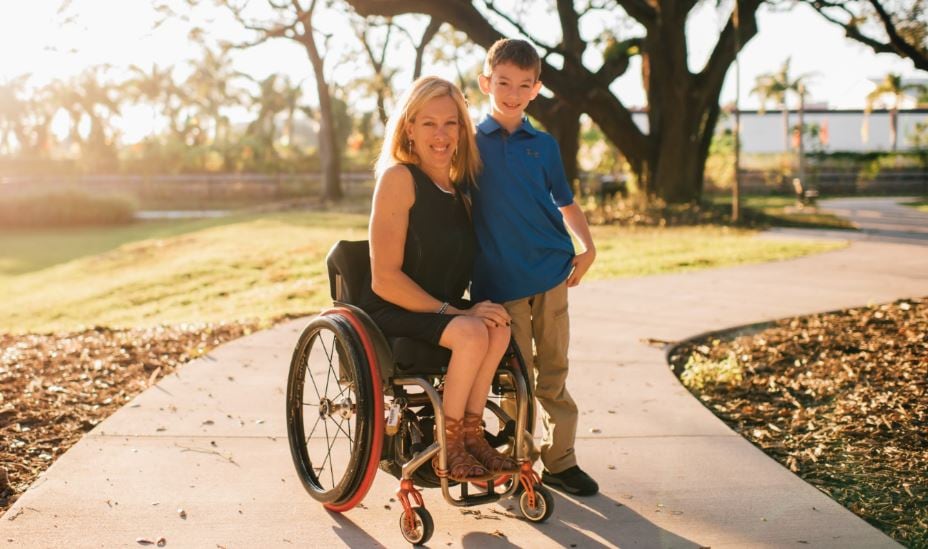
When a loved one suffers a spinal cord injury (SCI), parents often struggle with how to explain it to their children. This blog offers compassionate, practical advice for families (parents, caregivers, siblings) in the first few months after an SCI.
We explain how children of different ages perceive injury and disability, suggest simple, honest ways to describe the SCI, and offer tips to support kids’ emotional reactions like fear or grief. We also cover whether and how children can visit the hospital or help with care tasks, and point readers to additional support – including SpinalCord.com’s Recovery Advocate contact and the SCI Support Group Map – for further guidance.
## Children’s Understanding by Age
Children process serious illness or injury very differently at each developmental stage.
**Young children (ages 3–6)** think in very concrete terms: they may see the injured person as “hurt” or “broken” and might even worry they caused it. They need very simple explanations (for example, “Mommy’s back got hurt and it’s why she needs help walking now”).
**School-age children (7–12)** can handle more detail and may ask practical questions (“Will Dad ever walk again? Why does he have a tube?”).
**Teenagers (13–18)** understand more of the medical reality and long-term implications, but they still need honest answers. In all cases, parents should tailor explanations to the child’s age and maturity – being calm, factual, and straightforward.
Kids are often more perceptive than adults expect, so avoid “talking down” to them; answer only the questions they ask, and be honest (you can admit you “don’t know” some answers). For example, tell a young child simply that “the spine got badly hurt so [loved one] can’t feel or move parts of their body,” whereas an older child could learn that the spine is like a bundle of wires and now it can’t send messages past the injury. Reinforce that the injury is not the child’s fault and that doctors and family members are helping as much as they can.
## Explaining Spinal Cord Injury in an Age-Appropriate Way
Use clear, simple language and analogies. For example, you might say: “The spinal cord is like a big highway of nerves from the brain. When it’s injured, messages can’t get through the same way.”
Encourage questions and answer them honestly but without unnecessary details. It often helps to use visual aids or children’s books.
Kennedy Krieger Institute notes that child-life specialists have created storybook-style guides for preschoolers and school-age kids that explain SCI with simple words, pictures and activities. (For instance, one booklet uses playful drawings to show how someone with an SCI might walk with help.) Reading an age-appropriate book about disability or watching a short video together can also make the situation feel more concrete.
Emphasize what will stay the same (the person is still their parent/sibling and still loves them) and what has changed (e.g. needing a wheelchair or other help). By giving honest facts in kid-friendly terms, parents can prevent children’s imaginations from running wild with worse scenarios.
## Supporting Children’s Emotional Reactions
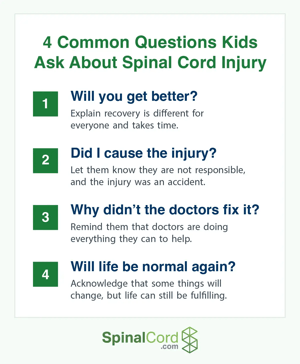Children’s feelings after a family SCI can range from **fear and confusion** to **sadness or anger**, depending on their age and temperament. It’s important to address these emotions directly.
AAP experts recommend the “3 R’s” of coping: **Reassure, Return to routine, Regulate**. For example: Remind your child they are **safe and loved**. Spend extra one-on-one time (hugs, reading together, playing) to show you care. Use soothing words and let them know it’s okay to feel scared or upset. Keep daily routines (meals, bedtime, school) as normal as possible to give a sense of stability.
Ask open-ended questions (“How are you feeling?”) and really listen to their answers. Let them express feelings through drawing, play, or talking. Stay calm when they act out – children often test boundaries when anxious.
Finally, help kids learn simple regulation techniques: teach deep breathing, count together, or identify where they feel an emotion in their body (e.g. “feel your heart beat fast when you’re scared”). These approaches help children manage worry or grief. If a child seems unusually withdrawn, fearful, or angry for an extended period, consider talking to a pediatric counselor or child-life specialist for extra support.
Offering reassurance and love goes a long way. Remind children often, “We are here for you and this is not your fault” – studies show kids cope better with the truth than with secret-keeping or misinformation. Use gentle routines (like reading the same bedtime story) to create “safe spaces” where the child feels in control.
Patience is key: young kids might ask the same questions over and over as they try to make sense of what happened. Praise them for sharing how they feel, and say things like “It’s OK to feel sad or scared.” By staying present, loving and consistent, parents become the “caring, accessible adult” that children need to build resilience.
## Involving Children in Hospital Visits and Daily Care
Children often want to help or visit the injured loved one in the hospital, but this should be handled carefully. It can help a child feel connected if the family member is in ICU or rehab, but **prepare the child first**. Explain what the hospital room is like (machines, nurses) and what they will see – for example, “Mommy might have machines to help her breathe, and she’ll be lying in bed.” Let children know they can stop the visit anytime if it’s too scary or tiring. After the visit, talk about how it went and answer any new questions. If in-person visiting isn’t possible, video calls or sending drawings and letters are good alternatives to maintain connection.
When the person returns home, children may want to be involved in care. **It’s okay to let them help with age-appropriate tasks**, as long as it’s safe.
For example, younger kids might enjoy helping hand a book to Dad in the wheelchair or learning how to press the elevator button. Older kids and teens could learn basic skills like how to reposition cushions or assist with small transfers (under close supervision) so they feel useful.
However, clear boundaries are crucial: children should never be expected to perform personal or medical care (like bathing or feeding) beyond their comfort and ability. As one guide notes, kids can participate – such as “pushing a wheelchair” or “helping pack a bag” – to stay involved, but should *not* become substitute caregivers. Throughout, continue to reassure the child that **they are not responsible** for the injury or care burden. Balance involvement with protection so the child feels helpful but not overwhelmed.
## Finding Additional Help and Support
Families do not have to go through this alone. In addition to support from friends and extended family, **professional and peer resources** can help:
- **SpinalCord.com Recovery Advocate:** Our site offers a personalized support service. You can contact a Recovery Advocate ([spinalcord.com/contact-us](https://www.spinalcord.com/contact-us)) to ask questions or get guidance on any aspect of coping with SCI.
- **Support Group Map:** Connecting with other families who have been through similar experiences can be a comfort. Use the SpinalCord.com [Support Group Map](https://www.spinalcord.com/spinal-cord-injury-support-groups-map) to find local or virtual SCI support groups in your area.
- **Pediatric specialists:** Hospitals often have child-life specialists, therapists or counselors who work with families during rehabilitation. They can coach parents on talking to kids and even meet with children individually. Don’t hesitate to ask the hospital staff what resources they have for families and siblings.
- **Educational resources:** Look for children’s books or activity kits about disability. Organizations like the Christopher & Dana Reeve Foundation publish kid-friendly SCI materials, and some children’s hospitals provide free booklets explaining SCI to kids (as noted above).
- **Counseling and community support:** If any family member, including the child, is struggling, consider a psychologist or support groups for caregivers of SCI patients. Faith communities or nonprofits (e.g. local disability or trauma support networks) may also have helpful programs or people you can lean on.
Families should take care of themselves too. Parents who manage their own stress and remain open about feelings help the whole family heal. By using these resources – plus the Recovery Advocate and group map on SpinalCord.com – you can find guidance and community while helping your children adjust after a spinal cord injury.
## Why SpinalCord.com Is Trusted
SpinalCord.com is a dedicated resource for the SCI community, authored by a team of medical professionals, attorneys and SCI survivors. We provide current, reliable information tailored to families facing SCI. Our site brings together medically accurate content, personal stories and support tools – like Recovery Advocates and support-group locators – specifically designed to guide people through recovery and adjustment. Families trust SpinalCord.com because we combine expert knowledge with genuine empathy for the challenges of spinal cord injury.
**Sources:** We drew on guidance from pediatric and rehabilitation experts and organizations. For example, the [American Academy of Pediatrics](https://www.healthychildren.org/English/healthy-living/emotional-wellness/Building-Resilience/Pages/Childhood-Trauma-3-Ways-to-Help-Kids-Cope.aspx) recommends honesty and routine to help children cope, and the [UK National Spinal Cord Injury Network](https://swspinalcordinjury.nhs.uk/patient-area/your-friends-and-family/) offers age-tailored tips for talking to kids about SCI. We also reference resources (like child-friendly SCI booklets) from the [Kennedy Krieger Institute](https://www.kennedykrieger.org/patient-care/centers-and-programs/international-center-for-spinal-cord-injury/news-resources/resources). These and other trusted sources inform the advice above.
---
**References**
Your friends and family – South West Spinal Cord Injury Network - [https://swspinalcordinjury.nhs.uk/patient-area/your-friends-and-family/](https://swspinalcordinjury.nhs.uk/patient-area/your-friends-and-family/)
Resources from the Spinal Cord Injury Program - [https://www.kennedykrieger.org/patient-care/centers-and-programs/international-center-for-spinal-cord-injury/news-resources/resources](https://www.kennedykrieger.org/patient-care/centers-and-programs/international-center-for-spinal-cord-injury/news-resources/resources)
Childhood Trauma: 3 Ways to Help Kids Cope - HealthyChildren.org - [https://www.healthychildren.org/English/healthy-living/emotional-wellness/Building-Resilience/Pages/Childhood-Trauma-3-Ways-to-Help-Kids-Cope.aspx](https://www.healthychildren.org/English/healthy-living/emotional-wellness/Building-Resilience/Pages/Childhood-Trauma-3-Ways-to-Help-Kids-Cope.aspx)
**Topics:** Parenting
### Stay Updated on Advancements On Traumatic Brain & Spinal Cord Injuries
About the Author
#### Spinal Cord Team
The authors of Spinalcord.com are made up of attorneys, those in the medical field, and survivors of spinal cord injuries or traumatic brain injuries. Learn more about our team of authors including a brief biography that explains how they impact the SCI and TBI community.
[Learn More About the Author](https://www.spinalcord.com/meet-our-authors)
**Leave a Comment**
[](https://cta-redirect.hubspot.com/cta/redirect/575040/dc8bc979-ba55-463a-9400-f92cbdebcb1a)
true
### Spinal Cord Injury
- [Types of Spinal Cord Injuries](https://www.spinalcord.com/types-of-spinal-cord-injuries)
- [Secondary Complications](https://www.spinalcord.com/secondary-complications-after-sci-spinal-cord-injury)
- [Causes](https://www.spinalcord.com/signs-symptoms-of-spinal-cord-injuries)
- [Symptoms](https://www.spinalcord.com/types-of-spinal-cord-injuries)
- [Prognosis](https://www.spinalcord.com/prognosis-of-spinal-cord-injuries)
- [Legal Help](https://www.spinalcord.com/spinal-cord-injury-legal-help-get-a-lawyer)
### Brain Injury
- [Types of Brain Injuries](https://www.spinalcord.com/types-of-traumatic-brain-injury)
- [Causes](https://www.spinalcord.com/causes-of-traumatic-and-acquired-brain-injuries)
- [Symptoms](https://www.spinalcord.com/traumatic-brain-injury-tbi-symptoms)
- [Prognosis](https://www.spinalcord.com/brain-injury-prognosis-for-tbi-abi)
- [Legal Help](https://www.spinalcord.com/brain-injury-legal-help-get-a-lawyer)
### Finding Treatment
- [Physician Directory](https://www.spinalcord.com/brain-and-spinal-cord-injury-physician-directory)
- [Rehabilitation Directory](https://www.spinalcord.com/spinal-cord-injury-hospitals-rehabilitation-directory)
- [Technology Advancements](https://www.spinalcord.com/sci-technology-advancements)
- [Prevention](https://www.spinalcord.com/spinal-cord-injury-prevention)
### Legal Options
- [Spinal Cord Injury Lawyer](https://www.spinalcord.com/spinal-cord-injury-lawyer)
- [Brain Injury Lawyer](https://www.spinalcord.com/brain-injury-lawyer)
- [Types of Personal Injury Claims](https://www.spinalcord.com/types-of-personal-injury-claims)
- [Where To Start](https://www.spinalcord.com/brain-spinal-cord-injury-lawyer-where-to-start)
- [Local Assistance](https://www.spinalcord.com/florida-personal-injury-claims)
#### [About Us](https://www.spinalcord.com/about-us)
Spinal cord injuries are traumatic for patients and their families. They cause disruptive changes to every aspect of your life and there is a lot of new information to navigate and understand. Our experts have collected everything in one place to help you learn more about your injury, locate doctors and treatment centers, find financial support, and get assistance navigating your next move.
[Learn More About SpinalCord.com →](https://www.spinalcord.com/about-us)
## [Contact Us](https://www.spinalcord.com/contact-us)

** [877-336-7192](tel:8773367192)
** [support@spinalcord.com](mailto:support@spinalcord.com)
[**](https://www.facebook.com/spinalcordcom) [**](https://www.linkedin.com/company/spinalcord-com/) [**](https://twitter.com/SpinalCordCom) [**](https://www.youtube.com/channel/UCAbz2AC18acXQkpMNPeDIqg)
Copyright 2026 | All Rights Reserved. [Spinal Cord, Inc.](https://www.spinalcord.com)
Sponsored by [Tampa personal injury lawyers](https://www.swoperodante.com/tampa-personal-injury-lawyer/) at Swope, Rodante P.A. a Florida law firm located at 1234 E 5th Ave, Tampa, FL 33605.
The information provided by SpinalCord.com is not a substitute for professional medical advice, diagnosis, or treatment, see [ Disclaimer Policy.](https://www.spinalcord.com/disclaimer)
[**](https://www.spinalcord.com/blog/how-to-talk-to-children-about-a-spinal-cord-injury#)
[**](https://www.spinalcord.com/blog/how-to-talk-to-children-about-a-spinal-cord-injury#)
```json
{
"@context" : "https://schema.org",
"@type" : "WebSite",
"name" : "Spinal Cord, Inc.",
"potentialAction" : {
"@type" : "SearchAction",
"query-input" : "required name=search_query",
"target" : "https://www.spinalcord.com/search?q={search_query}"
},
"url" : "https://www.spinalcord.com/"
}
```
```json
{
"@context" : "https://schema.org",
"@type" : "Organization",
"contactPoint" : [ {
"@type" : "ContactPoint",
"contactType" : "customer service",
"telephone" : "+1-877-336-7192"
} ],
"legalName" : "Spinal Cord, Inc.",
"logo" : "https://www.spinalcord.com/hubfs/Logos/spinal-cord_png.png",
"sameAs" : [ "https://www.facebook.com/spinalcordcom", "https://twitter.com/SpinalCordCom", "https://www.youtube.com/channel/UCAbz2AC18acXQkpMNPeDIqg", "http://www.linkedin.com/company/spinalcord-com" ],
"url" : "https://www.spinalcord.com/"
}
```
```json
{
"@context" : "http://schema.org",
"@type" : "Article",
"articleBody" : "The spinal cord is a vital part of the human body. As the vehicle responsible for carrying messages from the brain to the rest of the body and back again, even the smallest interference can be detrimental. Following a traumatic spinal cord injury, this bundle of nerves can become bruised, also known as a contusion. Because of the nature of the nervous system, any interference can constitute a serious spinal contusion, but these facts will help you dissect all of the information from the medical professionals.\n\nWhat Is a Spinal Contusion?
\n \n
\nMuch like any other bruise, a contusion can cause bleeding from local blood vessels and inflammation which, rather unlike bruises on other parts of the body, can have serious negative impacts on the spinal cord itself. Because the “blood must clot to stop the bleeding”a bruise results from contusions also increase cardiovascular risks.
\nFor example, the swelling a contusion can cause will often disrupt nerve impulses that travel from the brain to the body through the spinal cord, and the severity of this will depend upon the level of injury. Unlike a concussion, a contusion would not cause unconsciousness or a ‘blackout’, but instead cause the patient to feel a numbness or tingling in the extremities.
\nA contusion can cause spinal compression, which happens when there is pressure on the spinal cord. This can go on to cause an array of physical symptoms such as loss of sensation in the feet, inability to use the hands and loss of sexual ability. It must be noted that not all contusions cause spinal compression, and not all spinal compression is caused by a contusion, although they do often connect this way.
\nWarning Signs of a Serious Spinal Contusion to Watch For
\nFirstly, doctors will try and establish what area or limb the injury has affected. Spinal contusions most often “affect the upper extremities bilaterally and also sometimes involve the lower extremities,” according to Dr. Wong, an orthopedic physician.
\nSymptoms include “numbness, tingling, [or] electric shock-like sensations and burning in the extremities,” (American Association of Neurological Surgeons, 2016). Generally falling into the category of “spinal trauma” there are many symptoms which are similar to other forms of spinal trauma and spinal cord injury. Below are some symptoms of spinal trauma:
\n\n- Spinal shock — or the "loss of feeling or movement below site of injury" (Columbia University Medical Centre, 2016) that can last between hours and weeks
\n- Loss of bladder or bowel function
\n- Difficulty breathing
\n- Muscle spasticity
\n- Difficulty understanding speech
\n- Problems with attention
\n- Memory challenges
\n- Heart rate and blood pressure problems
\n
\nUnfortunately, it is sometimes challenging to identify which symptoms are due to a spinal contusion, and which ones are the result of a spinal cord injury directly. It can sometimes require a few days or weeks for the body to recover from spinal trauma and reveal if any permanent damage is left from the accident that caused the SCI.
\nUnderstanding what a contusion is, and how it can come into play following a spinal cord injury is important in order to clearly appreciate your injury, understand your diagnoses, and work toward treatment and a prognosis. Doctors can sometimes use jargon that’s difficult to understand, so the more you can educate yourself about your condition, the more control you can have in your recovery and treatment.
\nIf you still have questions about the details of the spinal cord and how it may be affected from your injury, please contact us or download our guide to understanding a spinal cord injury.",
"author" : {
"@type" : "Person",
"name" : "Spinalcord.com Team"
},
"datePublished" : "2020-12-03",
"image" : "https://www.spinalcord.com/blog/signs-of-a-serious-spinal-contusion",
"name" : "Warning Signs of a Serious Spinal Contusion",
"url" : "https://www.spinalcord.com/blog/signs-of-a-serious-spinal-contusion"
}
```
```json
{
"@context":"https://schema.org",
"@graph":[{"@type":"WebSite",
"@id":"https://spinalcord.com/#website",
"url":"https://www.spinalcord.com/blog/signs-of-a-serious-spinal-contusion",
"name":"Spinal Cord Inc",
"description":"The spinal cord is a vital part of the human body. As the vehicle responsible for carrying messages from the brain to the rest of the body and back again, even the smallest interference can be detrimental. Following a traumatic spinal cord injury, this bundle of nerves can become bruised, also known as a contusion. Because of the nature of the nervous system, any interference can constitute a serious spinal contusion, but these facts will help you dissect all of the information from the medical professionals.",
"inLanguage":"en-US"},
{
"@type":"ImageObject",
"@id":"Spinalcord Logo",
"inLanguage":"en-US",
"url":"https://www.spinalcord.com/hubfs/Logos/spinal-cord_png.png",
"width":327,"height":300,
"caption":"spinal contusion"},
{
"@type":"WebPage","@id":"https://www.spinalcord.com/blog/signs-of-a-serious-spinal-contusion/#webpage",
"url":"https://www.spinalcord.com/blog/signs-of-a-serious-spinal-contusion",
"name":"Warning Signs of a Serious Spinal Contusion",
"isPartOf":{"@id":"https://spinalcord.com/#website"},
"primaryImageOfPage":{"@id":"www.spinalcord.com/blog/signs-of-a-serious-spinal-contusion/#primaryimage"},
"datePublished":"2020-12-03T18:30:35+00:00","dateModified":"2020-12-03T18:30:35+00:00",
"author":{"@id":"https://www.spinalcord.com/meet-our-authors"},
"description":"The spinal cord is a vital part of the human body. As the vehicle responsible for carrying messages from the brain to the rest of the body and back again, even the smallest interference can be detrimental. Following a traumatic spinal cord injury, this bundle of nerves can become bruised, also known as a contusion. Because of the nature of the nervous system, any interference can constitute a serious spinal contusion, but these facts will help you dissect all of the information from the medical professionals.
What Is a Spinal Contusion?
Signs-of-a-spinal-contusion-title-image
Much like any other bruise, a contusion can cause bleeding from local blood vessels and inflammation which, rather unlike bruises on other parts of the body, can have serious negative impacts on the spinal cord itself. Because the “blood must clot to stop the bleeding”a bruise results from contusions also increase cardiovascular risks.
For example, the swelling a contusion can cause will often disrupt nerve impulses that travel from the brain to the body through the spinal cord, and the severity of this will depend upon the level of injury. Unlike a concussion, a contusion would not cause unconsciousness or a ‘blackout’, but instead cause the patient to feel a numbness or tingling in the extremities.
A contusion can cause spinal compression, which happens when there is pressure on the spinal cord. This can go on to cause an array of physical symptoms such as loss of sensation in the feet, inability to use the hands and loss of sexual ability. It must be noted that not all contusions cause spinal compression, and not all spinal compression is caused by a contusion, although they do often connect this way.
Warning Signs of a Serious Spinal Contusion to Watch For
Firstly, doctors will try and establish what area or limb the injury has affected. Spinal contusions most often “affect the upper extremities bilaterally and also sometimes involve the lower extremities,” according to Dr. Wong, an orthopedic physician.
Symptoms include “numbness, tingling, [or] electric shock-like sensations and burning in the extremities,” (American Association of Neurological Surgeons, 2016). Generally falling into the category of “spinal trauma” there are many symptoms which are similar to other forms of spinal trauma and spinal cord injury. Below are some symptoms of spinal trauma:
Spinal shock — or the loss of feeling or movement below site of injury (Columbia University Medical Centre, 2016) that can last between hours and weeks
Loss of bladder or bowel function
Difficulty breathing
Muscle spasticity
Difficulty understanding speech
Problems with attention
Memory challenges
Heart rate and blood pressure problems
Unfortunately, it is sometimes challenging to identify which symptoms are due to a spinal contusion, and which ones are the result of a spinal cord injury directly. It can sometimes require a few days or weeks for the body to recover from spinal trauma and reveal if any permanent damage is left from the accident that caused the SCI.
Understanding what a contusion is, and how it can come into play following a spinal cord injury is important in order to clearly appreciate your injury, understand your diagnoses, and work toward treatment and a prognosis. Doctors can sometimes use jargon that’s difficult to understand, so the more you can educate yourself about your condition, the more control you can have in your recovery and treatment.
If you still have questions about the details of the spinal cord and how it may be affected from your injury, please contact us or download our guide to understanding a spinal cord injury.",
"breadcrumb":{"@id":"https://www.spinalcord.com/blog/signs-of-a-serious-spinal-contusion/#breadcrumb"},
"inLanguage":"en-US","potentialAction":[{"@type":"ReadAction","target":["https://www.spinalcord.com/blog/signs-of-a-serious-spinal-contusion"]}]},
{
"@type":"BreadcrumbList",
"@id":"https://www.spinalcord.com/blog/signs-of-a-serious-spinal-contusion/#breadcrumb",
"itemListElement":[{"@type":"ListItem",
"position":1,
"item":
{
"@type":"WebPage",
"@id":"https://spinalcord.com/",
"url":"https://spinalcord.com/",
"name":"Home"}},
{"@type":"ListItem",
"position":2,
"item":{"@type":"WebPage",
"@id":"https://spinalcord.com/blog/",
"url":"https://spinalcord.com/blog/",
"name":"Articles"}},
{"@type":"ListItem",
"position":3,
"item":{"@type":"WebPage",
"@id":"https://www.spinalcord.com/blog/signs-of-a-serious-spinal-contusion/",
"url":"https://www.spinalcord.com/blog/signs-of-a-serious-spinal-contusion/",
"name":"Warning Signs of a Serious Spinal Contusion"}}]},
{"@type":"Person",
"@id":"https://www.spinalcord.com/meet-our-authors",
"name":"Spinalcord Team",
"image":{"@type":"ImageObject",
"@id":"https://www.spinalcord.com/hubfs/Logos/spinal-cord_png.png",
"inLanguage":"en-US",
"url":"https://www.spinalcord.com/hubfs/Logos/spinal-cord_png.png",
"caption":"Spinalcord Team"},
"description":"The authors at SpinalCord.com come from diverse backgrounds including doctors, attorneys, medical journalist, and survivors of spinal cord injuries or traumatic brain injuries. Each author brings with them different experiences and expertise which when combined provide clinically accurate information which is useful to all individuals in the spinal cord and traumatic brain injury communities. Within the content you will find citations to medical journals, scientific research, as well as national and local resources to provide immediate support to families in need of assistance. Content is reviewed and updated regularly with changes in the clinical guidelines, new resources, and fresh ways to understand the content such as videos and infographics. ."
}
]}
```