---
title: Preparing for Hospital Discharge After a Spinal Cord Injury
description: "Going home from the hospital after a spinal cord injury requires careful planning to ensure your home is accessible and safe, getting the necessary medical equipment, supplies, and home care services, and arranging follow-up appointments with your healthcare team.
In this article, we will guide you through the process of leaving inpatient rehab after a spinal cord injury (SCI) and returning home. We'll explain the discharge planning process, necessary home modifications and equipment, and what you and your family can expect during the transition."
image: https://www.spinalcord.com/hubfs/Blog-Images/Patient-in-wheelchair-pushed-by-nurse_227281572.jpg
---
[  ](https://www.spinalcord.com/)
MENU **

**
[
The Purpose Behind Spinalcord.com
** Play
Dale Swope's Story
](https://www.youtube.com/watch?v=C1kPXDw_CQU) [For Advice Call:
(877) 336-7192
](tel:8773367192) 
- [About](https://www.spinalcord.com/about-us)
- [About Us](https://www.spinalcord.com/about-us)
- [Our Team](https://www.spinalcord.com/our-team)
- [Trusted By](https://www.spinalcord.com/trusted-by)
- [Journal](https://www.spinalcord.com/blog)
- [Spinal Cord Injury](https://www.spinalcord.com/spinal-cord-injury)
- Spinal Injury Types
- [What is Spinal Cord?](https://www.spinalcord.com/what-is-the-spinal-cord)
- [Types of Spinal Cord Injuries](https://www.spinalcord.com/types-of-spinal-cord-injuries)
- [Secondary Complications](https://www.spinalcord.com/secondary-complications-after-sci-spinal-cord-injury)
- [Cervical Spine](https://www.spinalcord.com/cervical-spinal-cord-injury)
- [Thoracic Spine](https://www.spinalcord.com/thoracic-spinal-cord-injury)
- [Lumbar Spine](https://www.spinalcord.com/lumbar-l1-l5-vertebrae-spinal-cord-injury)
- [Sacral Spine](https://www.spinalcord.com/sacral-spine-s1-s5-vertebrae-injuries-sacral-sparing)
- Paralysis Types
- [Paralysis](https://www.spinalcord.com/paralysis)
- [Types of Paralysis](https://www.spinalcord.com/types-of-paralysis)
- [Monoplegia](https://www.spinalcord.com/monoplegia)
- [Diplegia](https://www.spinalcord.com/diplegia)
- [Hemiplegia](https://www.spinalcord.com/hemiplegia)
- [Paraplegia](https://www.spinalcord.com/paraplegia)
- [Quadriplegia | Tetraplegia](https://www.spinalcord.com/quadriplegia-tetraplegia)
- Additional Info
- [Spinal Cord Injury Lawyer](https://www.spinalcord.com/spinal-cord-injury-lawyer)
- [Causes](https://www.spinalcord.com/causes-of-non-traumatic-traumatic-spinal-cord-injuries)
- [Symptoms](https://www.spinalcord.com/signs-symptoms-of-spinal-cord-injuries)
- [Prognosis](https://www.spinalcord.com/prognosis-of-spinal-cord-injuries)
- [Mental Health Care After SCI](https://www.spinalcord.com/mental-health-care-after-sci)
- [Life After SCI](https://www.spinalcord.com/life-after-a-spinal-cord-injury)
- [Resources for Veterans](https://www.spinalcord.com/blog/topic/veterans)
- [Brain Injury](https://www.spinalcord.com/traumatic-brain-injury-acquired-brain-injury)
- Brain Injury Types
- [Traumatic Brain Injury](https://www.spinalcord.com/traumatic-brain-injury)
- [ Acquired Brain Injury](https://www.spinalcord.com/acquired-brain-injury)
- [Anoxic Brain Injury](https://www.spinalcord.com/anoxic-brain-injury)
- [Diffuse Axonal Brain Injury](https://www.spinalcord.com/diffuse-axonal-brain-injury)
- [ Focal Brain Injury](https://www.spinalcord.com/focal-brain-injury)
- [ Subdural Hematoma](https://www.spinalcord.com/subdural-hematoma)
- [ Concussion](https://www.spinalcord.com/concussion)
- [ Brain Aneurysm](https://www.spinalcord.com/brain-aneurysm)
- [ Coma](https://www.spinalcord.com/coma)
- Lobes of the Brain
- [ Brain Lobes Overview](https://www.spinalcord.com/lobes-of-the-brain)
- [ Frontal Lobe](https://www.spinalcord.com/frontal-lobe)
- [ Parietal Lobe](https://www.spinalcord.com/parietal-lobe)
- [ Occipital Lobe](https://www.spinalcord.com/occipital-lobe)
- [ Temporal Lobe](https://www.spinalcord.com/temporal-lobe)
- [ Limbic Lobe](https://www.spinalcord.com/limbic-lobe)
- [ Insular Cortex](https://www.spinalcord.com/insular-cortex)
- Additional Info
- [Brain Injury Treatment](https://www.spinalcord.com/brain-injury-treatment/brain-injury-lab)
- [ Brain Injury Lawyer](https://www.spinalcord.com/brain-injury-lawyer)
- [ Causes](https://www.spinalcord.com/causes-of-traumatic-and-acquired-brain-injuries)
- [ Symptoms](https://www.spinalcord.com/traumatic-brain-injury-tbi-symptoms)
- [ Prognosis](https://www.spinalcord.com/brain-injury-prognosis-for-tbi-abi)
- [ Resources For Veterans](https://www.spinalcord.com/blog/best-resources-for-veterans-with-spinal-cord-injuries)
- [Treatment ](https://www.spinalcord.com/treatment-for-brain-spinal-cord-injuries)
- [Physician Directory](https://www.spinalcord.com/brain-and-spinal-cord-injury-physician-directory)
- [Rehabilitation Directory](https://www.spinalcord.com/spinal-cord-injury-hospitals-rehabilitation-directory)
- [Intensive SCI Rehabilitation Centers](https://www.spinalcord.com/intensive-sci-rehabilitation-centers)
- [Technology Advancements ](https://www.spinalcord.com/sci-technology-advancements)
- [Activity Based Therapy Centers](https://www.spinalcord.com/activity-based-therapy-centers)
- [Brain Injury Treatment](https://www.spinalcord.com/brain-injury-treatment/brain-injury-lab)
- [Prevention](https://www.spinalcord.com/spinal-cord-injury-prevention)
- [Legal Options](https://www.spinalcord.com/legal-considerations-for-common-types-of-brain-and-spinal-cord-injuries)
- Legal Assistance
- [Brain Injury Lawyer](https://www.spinalcord.com/brain-injury-lawyer)
- [Spinal Cord Injury Lawyer](https://www.spinalcord.com/spinal-cord-injury-lawyer)
- [Where To Start](https://www.spinalcord.com/brain-spinal-cord-injury-lawyer-where-to-start)
- [When To Get A Lawyer - eBook](https://www.spinalcord.com/your-guide-to-knowing-when-to-get-a-lawyer)
- [Speak With An Injury Lawyer](https://www.spinalcord.com/spinal-cord-injury-legal-help-get-a-lawyer)
- [Protecting an Accident Scene](https://www.spinalcord.com/protecting-an-accident-crime-scene)
- Legal Considerations
- [Overview](https://www.spinalcord.com/legal-considerations-for-common-types-of-brain-and-spinal-cord-injuries)
- [Car Accidents](https://www.spinalcord.com/car-accidents)
- [Contact Sports](https://www.spinalcord.com/contact-sports)
- [Acts of Violence](https://www.spinalcord.com/acts-of-violence)
- [Workplace Injuries](https://www.spinalcord.com/workplace-injuries)
- [Slips and Falls](https://www.spinalcord.com/slips-and-falls)
- [Contusions](https://www.spinalcord.com/contusions)
- Personal Injury Claims
- [Types](https://www.spinalcord.com/types-of-personal-injury-claims)
- [How to File a Personal Injury Claim](https://www.spinalcord.com/how-to-file-a-personal-injury-claim-for-a-brain-or-spinal-cord-injury)
- [Resources](https://www.spinalcord.com/spinal-cord-resources)
- Coping & Support
- [Survivor Stories](https://www.spinalcord.com/blog/topic/survivor-stories-inspiration)
- [Family & Friends](https://www.spinalcord.com/family-friends-of-brain-spinal-cord-injury-patients)
- [Support Groups](https://www.spinalcord.com/spinal-cord-injury-support-groups)
- [Support Groups Interactive Map](https://www.spinalcord.com/spinal-cord-injury-support-groups-map)
- [Advocacy Groups](https://www.spinalcord.com/advocacy-groups)
- Financial Resources
- [Financial Help](https://www.spinalcord.com/financial-resources)
- [Grants](https://www.spinalcord.com/spinal-cord-injury-grants)
- [Compensation](https://www.spinalcord.com/spinal-cord-injury-compensation)
- [Brain & SCI Medical Expenses](https://www.spinalcord.com/brain-and-spinal-cord-injury-medical-expenses)
- [Money Management Tips](https://www.spinalcord.com/money-management-tips)
- [Life Care Plan](https://www.spinalcord.com/spinal-cord-injury-life-care-plan)
- Legal Assistance
- [Brain Injury Lawyer](https://www.spinalcord.com/brain-injury-lawyer)
- [Spinal Cord Injury Lawyer](https://www.spinalcord.com/spinal-cord-injury-lawyer)
- [Where To Start](https://www.spinalcord.com/brain-spinal-cord-injury-lawyer-where-to-start)
- [Speak With An Injury Lawyer](https://www.spinalcord.com/spinal-cord-injury-legal-help-get-a-lawyer)
- [Personal Injury Lawyer](https://www.swoperodante.com/tampa-personal-injury-lawyer/)
- Digital Resources
- [Frequently Asked Questions & Answers](https://www.spinalcord.com/frequently-asked-questions-and-answers)
- [When To Get A Lawyer](https://www.spinalcord.com/your-guide-to-knowing-when-to-get-a-lawyer)
- [Organizing Life From A Hospital](https://www.spinalcord.com/blog/traumatic-injury-digital-tools-organize-from-hospital)
- [Free Brain and Spinal Cord eBooks](https://www.spinalcord.com/spinal-cord-resources)
- [Spinal Cord Infographics](https://www.spinalcord.com/infographics)
- [SCI Life Uncovered Podcast](https://www.spinalcord.com/sci-life-uncovered/episode-1)
- Local Resources
- [Florida Spinal Cord Injury Resources ](https://www.spinalcord.com/florida-sci-resources)
- [Local Assistance](https://www.spinalcord.com/florida-personal-injury-claims)
- [Map of State Resources](https://www.spinalcord.com/state-programs)
- [Community](https://www.spinalcord.com/spinal-cord-injury-community)
- [Trusted Organizations](https://www.spinalcord.com/trusted-by-the-spinal-cord-injury-community)
- [Events Calendar](https://www.spinalcord.com/events)
- [Podcast](https://www.spinalcord.com/sci-life-uncovered/episode-1)
- Recognition
- [Best of Awards](https://www.spinalcord.com/best-of-awards)
- [Trusted By Designation](https://www.spinalcord.com/trusted-by-the-spinal-cord-injury-community)
- [** ](tel:8773367192)
- [** ](https://www.spinalcord.com/blog/navigating-discharge-how-to-prepare-for-going-home-after-sci#)
- [**
**(877) 336-7192**
](tel:8773367192)
- [**
**Contact Us**
](https://www.spinalcord.com/contact-us)
# Preparing for Hospital Discharge After a Spinal Cord Injury
Author: [Spinal Cord Team](https://www.spinalcord.com/meet-our-authors)
Publish Date: December 16, 2025
Going home from the hospital after a spinal cord injury requires careful planning to ensure your home is accessible and safe, getting the necessary medical equipment, supplies, and home care services, and arranging follow-up appointments with your healthcare team.
In this article, we will guide you through the process of leaving inpatient rehab after a spinal cord injury (SCI) and returning home. We'll explain the discharge planning process, necessary home modifications and equipment, and what you and your family can expect during the transition.

## Discharge Planning Process After SCI
Your medical and rehab team will start discharge planning as soon as you are admitted for rehabilitation. Nurses, therapists, social workers and case managers work together with you and your family to build a plan for your homecoming. This plan covers your medical needs, home situation, equipment and caregiver support.
For example, a physical or occupational therapist meets with the patient and [talks with the medical team and nurse care coordinator to form a discharge plan](https://www.uhhospitals.org/-/media/files/services/surgery/spinal-cord-injury-family-handout.pdf). These meetings may include your family or other caregivers. Together you'll set goals (like independence with transfers or self-care) and decide what level of home support and equipment you need.
Typical steps include:
- **Team meetings:** Your rehab team regularly discusses progress and needs. They will schedule a family meeting to explain the plan. You'll be encouraged to participate, ask questions, and give input.
- **Case manager involvement:** A nurse or social worker ("case manager") helps coordinate medical equipment, home care orders, therapy appointments and insurance/benefits as you prepare to leave the hospital. They update your plan continually so nothing is missed.
- **Home assessment:** Before discharge, someone may review your home environment (or have you complete a questionnaire) to identify access barriers. Your therapists or case manager may even visit home to recommend changes like ramps or shower benches.
- **Training and practice:** In rehab, you will practice daily tasks (transfers, wheelchair skills, self-care) and train caregivers so you can manage safely at home. Education on skin care, bowel/bladder care, and signs of complications is provided.
Researchers stress that [successful discharge from rehabilitation for patients with spinal cord injury relies on a smooth transition home](https://sajp.co.za/index.php/sajp/article/view/437/0). Assessing your readiness to leave can reduce complications and improve satisfaction. In other words, the more prepared you feel (and the more support is arranged), the better you will cope at home. Working closely with your rehab team and case manager ensures your discharge plan covers everything from equipment to follow-up care.
## Preparing Your Home: Equipment and Modifications
Making your home safe and accessible is a top priority. Think about changes that let you move around independently. For example, you may need **a ramp or platform lift at your entrance, a hospital-style bed, and grab bars or a roll-in shower in the bathroom**. Your team will help identify these needs. As a [VA guide](https://www.veteranshealthlibrary.va.gov/LivingWith/SpinalCordInjury/coping/3,41183) advises, "When planning your return home, consider modifications and equipment. Think about changes to your home such as ramps and other things that will make spaces in your home easier to move around in."
Common modifications include:
- **Entrances and doors:** Install a ramp or lift at any steps and widen doorways so a wheelchair or walker can pass through. Replace doorknobs with lever handles.
- **Floors and surfaces:** Use slip-resistant flooring (especially in showers), remove loose rugs, and make sure hallways and rooms have clear, level paths for maneuvering.
- **Bathroom adaptations:** Add a roll-in shower or tub bench, grab bars by the toilet and in the shower, and a raised toilet seat. Consider a handheld shower head and non-skid mats.
- **Bedroom and living areas:** Get a bed that adjusts in height. Arrange furniture to allow wheelchair access. Lower light switches and countertops if needed. Keep frequently used items within easy reach.
Your insurance or local disability programs may cover many of these changes. Veterans should ask their SCI/D team about [housing adaptation grants and ramps or grab bars](https://www.veteranshealthlibrary.va.gov/LivingWith/ALS/Coping/142,41181_VA). Even if you have to fund some upgrades, think of it as an investment in safety and independence.
## Transitioning Home: What to Expect
Going home after rehab often involves family members or caregivers helping with transfers, transportation, and daily routines. You're not alone in this process. The first day or two at home can be challenging: new routines, schedules for meds or catheter changes, and lots to remember. It's normal for you and your family to feel both excited and anxious. Expect that caregiving tasks will shift more to your household. A spouse, parent, or hired aide may help with bathing, dressing, meal prep, driving to appointments, and other tasks.
You may feel tired at first. Your body has been working hard in rehab, and it will keep adjusting at home. You might need more rest breaks and may not feel fully confident until you've practiced routines a few times in the familiar surroundings. That's okay. **Plan for some "learning curve" time**. Speak openly with your therapists about what you can do independently and what tasks you still need assistance with. By discharge, most teams set you up with home health nurses or therapists who come visit to check that you're managing well.
A helpful tip is to set up a **home health schedule** immediately: arrange for at least a nurse visit after a few days home (to review wound care, catheters, etc.), and start outpatient therapy (PT/OT) as recommended. If you can, have the first home visit on a day with family available so everyone gets questions answered.
## Preparing Emotionally and Logistically
Going home after an SCI is not just a physical change but an emotional one too. It's common to feel overwhelmed, frustrated, or even grieving the loss of your previous independence. **Recognize those feelings are normal**, and know that support is available. In fact, studies show about [one-third of people with SCI experience depression at some point](https://www.veteranshealthlibrary.va.gov/142,41191_VA).
You don't have to cope alone. Talking with a counselor, psychologist, or peer mentor can help you process emotions and stay motivated. Your rehab center can often connect you to a counselor, or you may find support in group therapy or online SCI communities (see resources below).
Logistically, **plan ahead** to avoid stress. Make checklists for:
- **Medical needs:** List your medications, doctors, and any therapies. Ensure prescriptions are filled before discharge. Set up durable medical equipment deliveries (like catheters or supplies) to arrive at your home.
- **Caregiver planning:** Identify who will help you each day and for what tasks. If you hire home care, arrange that before leaving the hospital. Train your caregiver during your rehab stay on transfers and catheter care.
- **Transportation:** Decide how you'll get to appointments. If you can't drive immediately, look into local paratransit (dial-a-ride) services or ask friends/family for a schedule. If you'll drive, plan for any vehicle modifications.
- **Finances and paperwork:** Check on insurance coverage and any benefits (like Social Security disability). A social worker can guide you to financial resources or programs that help cover rehab costs, home mods, or caregiving (for example, Medicaid waivers or VA benefits).
Emotionally, keep communication open with your family. They too may be adjusting to new roles. Consider setting up a family meeting (with your rehab social worker) to discuss expectations and concerns. You might also benefit from peer mentors or support groups.
Talking with others who've "been there" can be very reassuring. SpinalCord.com's [Recovery Advocates](https://www.spinalcord.com/contact-us) are trained peers who offer practical tips and encouragement by phone or email. Our [Spinal Cord Injury Support Group Map](https://www.spinalcord.com/spinal-cord-injury-support-groups-map) can help your family find local or virtual support groups for additional guidance.
## Post-Discharge Support Services
[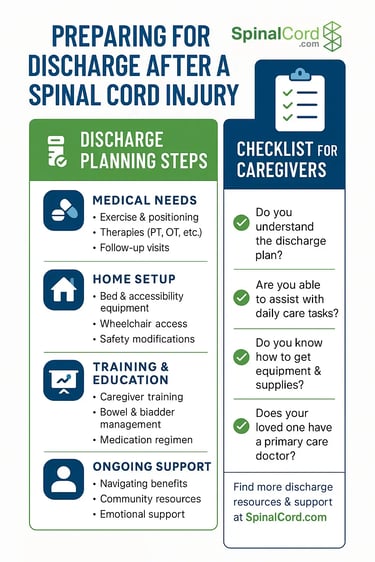](https://www.spinalcord.com/hubfs/Preparing%20to%20Leave%20the%20Hospital%20After%20a%20Spinal%20Cord%20Injury.webp)After discharge, many services are available to help you regain independence:
- **Home Health Care:** Nurses or therapists visit your home to teach care skills (like bowel/bladder management or wound care) and monitor your health.
- **Outpatient Rehabilitation:** You'll likely continue physical therapy (PT) and occupational therapy (OT) on an outpatient basis. These help improve strength, teach adaptive techniques, and progress mobility goals.
- **Medical Follow-Up:** You will have regular check-ups with specialists (like a physiatrist or urologist). Keep all appointments and tell your doctors about any new problems (like pressure sores or autonomic dysreflexia symptoms).
- **Adaptive Equipment Services:** Organizations like the VA or local assistive technology programs can provide equipment loans (wheelchairs, shower chairs, etc.) or home modifications. Your rehab team or SpinalCord.com's [State SCI Resources](https://www.spinalcord.com/state-programs) page can direct you to these programs by state.
- **Peer Support:** Talk with a peer counselor or join an SCI peer support group. It can be very motivating to meet others who have adjusted successfully. Many areas offer SCI "peer mentoring" through local hospitals or organizations like United Spinal Association.
- **Specialty Programs:** Recreational therapy, vocational rehab, and adaptive sports programs can help you reintegrate socially and physically. Ask your rehab staff about community rehab programs (like wheelchair sports or job training).
Remember, even after you leave the hospital, *you still have a care team*. If you ever feel unprepared or need advice, call your discharge coordinator or therapy team. They expect that the transition is an adjustment and can help fine-tune your home plan. If insurance or distance is an issue, many teams offer phone follow-ups.
SpinalCord.com also offers ongoing support. Besides our Recovery Advocates, our website has [infographics](https://www.spinalcord.com/infographics) that explain self-care (skin checks, catheter routines, etc.) and community guides. We maintain a **National SCI Resource Center** with links to nonprofit organizations, legal assistance, and more. Don't hesitate to reach out. We're here to help you through the tough early months and beyond.
## Why SpinalCord.com Is Trusted
- **Decades of Expertise:** SpinalCord.com has provided authoritative SCI information since 2004. Our content is reviewed by medical professionals and people living with SCI.
- **Comprehensive Support:** We cover everything from medical care to daily living and emotional health, so you get a complete picture of life after SCI.
- **Community Connections:** Through our Recovery Advocates and support group network, we put you in touch with trained peers and caregivers who understand SCI firsthand.
- **Up-to-Date Resources:** We continually update our state-by-state program guides, infographics, and articles so you have the latest information at your fingertips.
SpinalCord.com is a dedicated community for SCI survivors and caregivers. We provide trusted guidance, helpful tools, and a caring network to support you every step of the way.
**Sources:** Authoritative resources such as university and hospital publications and VA health guides were used to ensure accuracy. For example, rehab specialists note that forming a discharge plan with the care team is vital, and VA guides highlight the importance of home ramps, adaptive beds and getting help from peer counselors. We strive to provide information consistent with current best practices in SCI care.
---
**References**
[Traumatic Brain Injury Patient and Caregiver Education - UH Hospitals](https://www.uhhospitals.org/-/media/files/services/surgery/spinal-cord-injury-family-handout.pdf)
[Perceived readiness for hospital discharge: Patients with spinal cord injury versus physiotherapists - South African Journal of Physiotherapy](https://sajp.co.za/index.php/sajp/article/view/437/0)
[Spinal Cord Injury (SCI): Your Transition Home - Veterans Affairs](https://www.veteranshealthlibrary.va.gov/LivingWith/SpinalCordInjury/coping/3,41183)
[Spinal Cord Injury or Disorder: Home Modifications - Veterans Affairs](https://www.veteranshealthlibrary.va.gov/LivingWith/ALS/Coping/142,41181_VA)
[Depression and Spinal Cord Injuries and Disorders - Veterans Affairs](https://www.veteranshealthlibrary.va.gov/142,41191_VA)
**Topics:** Recovery & Rehabilitation
### Stay Updated on Advancements On Traumatic Brain & Spinal Cord Injuries
About the Author
#### Spinal Cord Team
The authors of Spinalcord.com are made up of attorneys, those in the medical field, and survivors of spinal cord injuries or traumatic brain injuries. Learn more about our team of authors including a brief biography that explains how they impact the SCI and TBI community.
[Learn More About the Author](https://www.spinalcord.com/meet-our-authors)
**Leave a Comment**
[](https://cta-redirect.hubspot.com/cta/redirect/575040/dc8bc979-ba55-463a-9400-f92cbdebcb1a)
true
### Spinal Cord Injury
- [Types of Spinal Cord Injuries](https://www.spinalcord.com/types-of-spinal-cord-injuries)
- [Secondary Complications](https://www.spinalcord.com/secondary-complications-after-sci-spinal-cord-injury)
- [Causes](https://www.spinalcord.com/signs-symptoms-of-spinal-cord-injuries)
- [Symptoms](https://www.spinalcord.com/types-of-spinal-cord-injuries)
- [Prognosis](https://www.spinalcord.com/prognosis-of-spinal-cord-injuries)
- [Legal Help](https://www.spinalcord.com/spinal-cord-injury-legal-help-get-a-lawyer)
### Brain Injury
- [Types of Brain Injuries](https://www.spinalcord.com/types-of-traumatic-brain-injury)
- [Causes](https://www.spinalcord.com/causes-of-traumatic-and-acquired-brain-injuries)
- [Symptoms](https://www.spinalcord.com/traumatic-brain-injury-tbi-symptoms)
- [Prognosis](https://www.spinalcord.com/brain-injury-prognosis-for-tbi-abi)
- [Legal Help](https://www.spinalcord.com/brain-injury-legal-help-get-a-lawyer)
### Finding Treatment
- [Physician Directory](https://www.spinalcord.com/brain-and-spinal-cord-injury-physician-directory)
- [Rehabilitation Directory](https://www.spinalcord.com/spinal-cord-injury-hospitals-rehabilitation-directory)
- [Technology Advancements](https://www.spinalcord.com/sci-technology-advancements)
- [Prevention](https://www.spinalcord.com/spinal-cord-injury-prevention)
### Legal Options
- [Spinal Cord Injury Lawyer](https://www.spinalcord.com/spinal-cord-injury-lawyer)
- [Brain Injury Lawyer](https://www.spinalcord.com/brain-injury-lawyer)
- [Types of Personal Injury Claims](https://www.spinalcord.com/types-of-personal-injury-claims)
- [Where To Start](https://www.spinalcord.com/brain-spinal-cord-injury-lawyer-where-to-start)
- [Local Assistance](https://www.spinalcord.com/florida-personal-injury-claims)
#### [About Us](https://www.spinalcord.com/about-us)
Spinal cord injuries are traumatic for patients and their families. They cause disruptive changes to every aspect of your life and there is a lot of new information to navigate and understand. Our experts have collected everything in one place to help you learn more about your injury, locate doctors and treatment centers, find financial support, and get assistance navigating your next move.
[Learn More About SpinalCord.com →](https://www.spinalcord.com/about-us)
## [Contact Us](https://www.spinalcord.com/contact-us)

** [877-336-7192](tel:8773367192)
** [support@spinalcord.com](mailto:support@spinalcord.com)
[**](https://www.facebook.com/spinalcordcom) [**](https://www.linkedin.com/company/spinalcord-com/) [**](https://twitter.com/SpinalCordCom) [**](https://www.youtube.com/channel/UCAbz2AC18acXQkpMNPeDIqg)
Copyright 2026 | All Rights Reserved. [Spinal Cord, Inc.](https://www.spinalcord.com)
Sponsored by [Tampa personal injury lawyers](https://www.swoperodante.com/tampa-personal-injury-lawyer/) at Swope, Rodante P.A. a Florida law firm located at 1234 E 5th Ave, Tampa, FL 33605.
The information provided by SpinalCord.com is not a substitute for professional medical advice, diagnosis, or treatment, see [ Disclaimer Policy.](https://www.spinalcord.com/disclaimer)
[**](https://www.spinalcord.com/blog/navigating-discharge-how-to-prepare-for-going-home-after-sci#)
[**](https://www.spinalcord.com/blog/navigating-discharge-how-to-prepare-for-going-home-after-sci#)
```json
{
"@context" : "https://schema.org",
"@type" : "WebSite",
"name" : "Spinal Cord, Inc.",
"potentialAction" : {
"@type" : "SearchAction",
"query-input" : "required name=search_query",
"target" : "https://www.spinalcord.com/search?q={search_query}"
},
"url" : "https://www.spinalcord.com/"
}
```
```json
{
"@context" : "https://schema.org",
"@type" : "Organization",
"contactPoint" : [ {
"@type" : "ContactPoint",
"contactType" : "customer service",
"telephone" : "+1-877-336-7192"
} ],
"legalName" : "Spinal Cord, Inc.",
"logo" : "https://www.spinalcord.com/hubfs/Logos/spinal-cord_png.png",
"sameAs" : [ "https://www.facebook.com/spinalcordcom", "https://twitter.com/SpinalCordCom", "https://www.youtube.com/channel/UCAbz2AC18acXQkpMNPeDIqg", "http://www.linkedin.com/company/spinalcord-com" ],
"url" : "https://www.spinalcord.com/"
}
```
```json
{
"@context" : "http://schema.org",
"@type" : "Article",
"articleBody" : "The spinal cord is a vital part of the human body. As the vehicle responsible for carrying messages from the brain to the rest of the body and back again, even the smallest interference can be detrimental. Following a traumatic spinal cord injury, this bundle of nerves can become bruised, also known as a contusion. Because of the nature of the nervous system, any interference can constitute a serious spinal contusion, but these facts will help you dissect all of the information from the medical professionals.\n\nWhat Is a Spinal Contusion?
\n \n
\nMuch like any other bruise, a contusion can cause bleeding from local blood vessels and inflammation which, rather unlike bruises on other parts of the body, can have serious negative impacts on the spinal cord itself. Because the “blood must clot to stop the bleeding”a bruise results from contusions also increase cardiovascular risks.
\nFor example, the swelling a contusion can cause will often disrupt nerve impulses that travel from the brain to the body through the spinal cord, and the severity of this will depend upon the level of injury. Unlike a concussion, a contusion would not cause unconsciousness or a ‘blackout’, but instead cause the patient to feel a numbness or tingling in the extremities.
\nA contusion can cause spinal compression, which happens when there is pressure on the spinal cord. This can go on to cause an array of physical symptoms such as loss of sensation in the feet, inability to use the hands and loss of sexual ability. It must be noted that not all contusions cause spinal compression, and not all spinal compression is caused by a contusion, although they do often connect this way.
\nWarning Signs of a Serious Spinal Contusion to Watch For
\nFirstly, doctors will try and establish what area or limb the injury has affected. Spinal contusions most often “affect the upper extremities bilaterally and also sometimes involve the lower extremities,” according to Dr. Wong, an orthopedic physician.
\nSymptoms include “numbness, tingling, [or] electric shock-like sensations and burning in the extremities,” (American Association of Neurological Surgeons, 2016). Generally falling into the category of “spinal trauma” there are many symptoms which are similar to other forms of spinal trauma and spinal cord injury. Below are some symptoms of spinal trauma:
\n\n- Spinal shock — or the "loss of feeling or movement below site of injury" (Columbia University Medical Centre, 2016) that can last between hours and weeks
\n- Loss of bladder or bowel function
\n- Difficulty breathing
\n- Muscle spasticity
\n- Difficulty understanding speech
\n- Problems with attention
\n- Memory challenges
\n- Heart rate and blood pressure problems
\n
\nUnfortunately, it is sometimes challenging to identify which symptoms are due to a spinal contusion, and which ones are the result of a spinal cord injury directly. It can sometimes require a few days or weeks for the body to recover from spinal trauma and reveal if any permanent damage is left from the accident that caused the SCI.
\nUnderstanding what a contusion is, and how it can come into play following a spinal cord injury is important in order to clearly appreciate your injury, understand your diagnoses, and work toward treatment and a prognosis. Doctors can sometimes use jargon that’s difficult to understand, so the more you can educate yourself about your condition, the more control you can have in your recovery and treatment.
\nIf you still have questions about the details of the spinal cord and how it may be affected from your injury, please contact us or download our guide to understanding a spinal cord injury.",
"author" : {
"@type" : "Person",
"name" : "Spinalcord.com Team"
},
"datePublished" : "2020-12-03",
"image" : "https://www.spinalcord.com/blog/signs-of-a-serious-spinal-contusion",
"name" : "Warning Signs of a Serious Spinal Contusion",
"url" : "https://www.spinalcord.com/blog/signs-of-a-serious-spinal-contusion"
}
```
```json
{
"@context":"https://schema.org",
"@graph":[{"@type":"WebSite",
"@id":"https://spinalcord.com/#website",
"url":"https://www.spinalcord.com/blog/signs-of-a-serious-spinal-contusion",
"name":"Spinal Cord Inc",
"description":"The spinal cord is a vital part of the human body. As the vehicle responsible for carrying messages from the brain to the rest of the body and back again, even the smallest interference can be detrimental. Following a traumatic spinal cord injury, this bundle of nerves can become bruised, also known as a contusion. Because of the nature of the nervous system, any interference can constitute a serious spinal contusion, but these facts will help you dissect all of the information from the medical professionals.",
"inLanguage":"en-US"},
{
"@type":"ImageObject",
"@id":"Spinalcord Logo",
"inLanguage":"en-US",
"url":"https://www.spinalcord.com/hubfs/Logos/spinal-cord_png.png",
"width":327,"height":300,
"caption":"spinal contusion"},
{
"@type":"WebPage","@id":"https://www.spinalcord.com/blog/signs-of-a-serious-spinal-contusion/#webpage",
"url":"https://www.spinalcord.com/blog/signs-of-a-serious-spinal-contusion",
"name":"Warning Signs of a Serious Spinal Contusion",
"isPartOf":{"@id":"https://spinalcord.com/#website"},
"primaryImageOfPage":{"@id":"www.spinalcord.com/blog/signs-of-a-serious-spinal-contusion/#primaryimage"},
"datePublished":"2020-12-03T18:30:35+00:00","dateModified":"2020-12-03T18:30:35+00:00",
"author":{"@id":"https://www.spinalcord.com/meet-our-authors"},
"description":"The spinal cord is a vital part of the human body. As the vehicle responsible for carrying messages from the brain to the rest of the body and back again, even the smallest interference can be detrimental. Following a traumatic spinal cord injury, this bundle of nerves can become bruised, also known as a contusion. Because of the nature of the nervous system, any interference can constitute a serious spinal contusion, but these facts will help you dissect all of the information from the medical professionals.
What Is a Spinal Contusion?
Signs-of-a-spinal-contusion-title-image
Much like any other bruise, a contusion can cause bleeding from local blood vessels and inflammation which, rather unlike bruises on other parts of the body, can have serious negative impacts on the spinal cord itself. Because the “blood must clot to stop the bleeding”a bruise results from contusions also increase cardiovascular risks.
For example, the swelling a contusion can cause will often disrupt nerve impulses that travel from the brain to the body through the spinal cord, and the severity of this will depend upon the level of injury. Unlike a concussion, a contusion would not cause unconsciousness or a ‘blackout’, but instead cause the patient to feel a numbness or tingling in the extremities.
A contusion can cause spinal compression, which happens when there is pressure on the spinal cord. This can go on to cause an array of physical symptoms such as loss of sensation in the feet, inability to use the hands and loss of sexual ability. It must be noted that not all contusions cause spinal compression, and not all spinal compression is caused by a contusion, although they do often connect this way.
Warning Signs of a Serious Spinal Contusion to Watch For
Firstly, doctors will try and establish what area or limb the injury has affected. Spinal contusions most often “affect the upper extremities bilaterally and also sometimes involve the lower extremities,” according to Dr. Wong, an orthopedic physician.
Symptoms include “numbness, tingling, [or] electric shock-like sensations and burning in the extremities,” (American Association of Neurological Surgeons, 2016). Generally falling into the category of “spinal trauma” there are many symptoms which are similar to other forms of spinal trauma and spinal cord injury. Below are some symptoms of spinal trauma:
Spinal shock — or the loss of feeling or movement below site of injury (Columbia University Medical Centre, 2016) that can last between hours and weeks
Loss of bladder or bowel function
Difficulty breathing
Muscle spasticity
Difficulty understanding speech
Problems with attention
Memory challenges
Heart rate and blood pressure problems
Unfortunately, it is sometimes challenging to identify which symptoms are due to a spinal contusion, and which ones are the result of a spinal cord injury directly. It can sometimes require a few days or weeks for the body to recover from spinal trauma and reveal if any permanent damage is left from the accident that caused the SCI.
Understanding what a contusion is, and how it can come into play following a spinal cord injury is important in order to clearly appreciate your injury, understand your diagnoses, and work toward treatment and a prognosis. Doctors can sometimes use jargon that’s difficult to understand, so the more you can educate yourself about your condition, the more control you can have in your recovery and treatment.
If you still have questions about the details of the spinal cord and how it may be affected from your injury, please contact us or download our guide to understanding a spinal cord injury.",
"breadcrumb":{"@id":"https://www.spinalcord.com/blog/signs-of-a-serious-spinal-contusion/#breadcrumb"},
"inLanguage":"en-US","potentialAction":[{"@type":"ReadAction","target":["https://www.spinalcord.com/blog/signs-of-a-serious-spinal-contusion"]}]},
{
"@type":"BreadcrumbList",
"@id":"https://www.spinalcord.com/blog/signs-of-a-serious-spinal-contusion/#breadcrumb",
"itemListElement":[{"@type":"ListItem",
"position":1,
"item":
{
"@type":"WebPage",
"@id":"https://spinalcord.com/",
"url":"https://spinalcord.com/",
"name":"Home"}},
{"@type":"ListItem",
"position":2,
"item":{"@type":"WebPage",
"@id":"https://spinalcord.com/blog/",
"url":"https://spinalcord.com/blog/",
"name":"Articles"}},
{"@type":"ListItem",
"position":3,
"item":{"@type":"WebPage",
"@id":"https://www.spinalcord.com/blog/signs-of-a-serious-spinal-contusion/",
"url":"https://www.spinalcord.com/blog/signs-of-a-serious-spinal-contusion/",
"name":"Warning Signs of a Serious Spinal Contusion"}}]},
{"@type":"Person",
"@id":"https://www.spinalcord.com/meet-our-authors",
"name":"Spinalcord Team",
"image":{"@type":"ImageObject",
"@id":"https://www.spinalcord.com/hubfs/Logos/spinal-cord_png.png",
"inLanguage":"en-US",
"url":"https://www.spinalcord.com/hubfs/Logos/spinal-cord_png.png",
"caption":"Spinalcord Team"},
"description":"The authors at SpinalCord.com come from diverse backgrounds including doctors, attorneys, medical journalist, and survivors of spinal cord injuries or traumatic brain injuries. Each author brings with them different experiences and expertise which when combined provide clinically accurate information which is useful to all individuals in the spinal cord and traumatic brain injury communities. Within the content you will find citations to medical journals, scientific research, as well as national and local resources to provide immediate support to families in need of assistance. Content is reviewed and updated regularly with changes in the clinical guidelines, new resources, and fresh ways to understand the content such as videos and infographics. ."
}
]}
```